APRLOG / All articles / OPN Launchpool, pool by pool: what $1,000 earned in BNB, USDC, U and USD1
OPN Launchpool, pool by pool: what $1,000 earned in BNB, USDC, U and USD1
The Opinion (OPN) Launchpool of early March 2026 differed in one respect from the HODLer airdrops reviewed elsewhere on this site: it ran four pools. Alongside BNB you could stake USDC, U or USD1. Which makes a sharper question available — if the balance sitting idle is a stablecoin, which pool hands back the most? And if you hold BNB instead? One round, worked out here.
The short version: taking Binance's published average payout per unit and converting at OPN's close on listing day, every $1,000 collected roughly $0.40 in the USDC pool, $0.44 in USD1, $0.55 in BNB and $0.81 in U. Even the best pool came to under a tenth of one percent of the stake. By the close of 2026-09-15, OPN had fallen about 88% from its listing day.
What Binance actually published
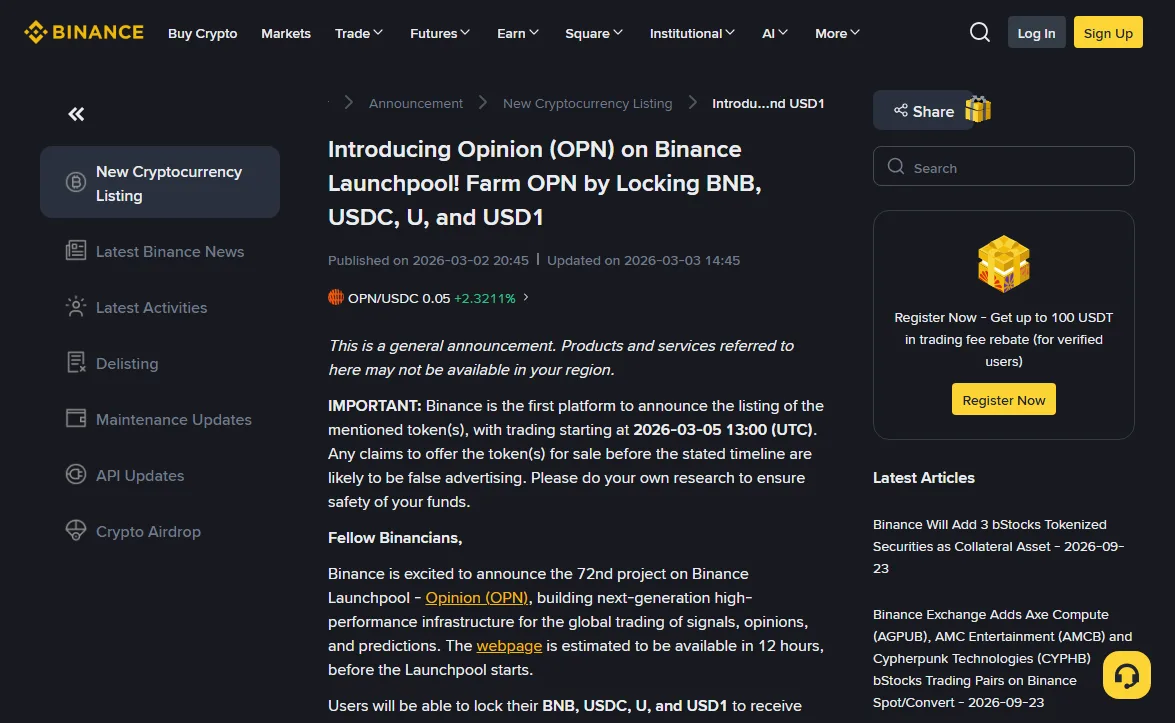
The rules come from the announcement dated 2026-03-02. Farming ran two days, 2026-03-03 00:00 to 2026-03-04 23:59 UTC, with 20 million OPN on offer — 2% of total supply. Spot trading opened 2026-03-05 13:00 UTC. A small detail from the announcement, visible in the screenshot below: when it went out, the pool page had yet to appear, and readers were told to expect it within twelve hours.
Once a round closes, the Launchpool page files it under finished projects and shows, for each pool, the average OPN received per unit of asset staked. By default that block only exposes the most recent few projects; OPN sits behind the View More button.
| Pool | Reward (OPN) | Share | Average OPN per unit | Hourly cap per user (OPN) |
|---|---|---|---|---|
| BNB | 16,000,000 | 80% | 0.9684 | 33,333 |
| USDC | 2,000,000 | 10% | 0.0011 | 4,166 |
| U | 1,000,000 | 5% | 0.0022 | 2,083 |
| USD1 | 1,000,000 | 5% | 0.0012 | 2,083 |
Reward size, share and hourly cap from the official announcement; average per unit from the finished-projects block on the Binance Launchpool page. Both checked 2026-09-16.
Skip the hourly cap column. Working backwards from the BNB pool's average, an account would have to lock something over 1.6 million BNB before the cap bit — roughly a tenth of the whole pool.
The same $1,000, four different pools
For the stablecoin pools a unit is one coin, and all three are counted at a dollar here, ignoring the small drift between them and the dollar. The BNB pool needs a conversion first: at 645.78 USDT — the average of the daily closes across the two farming days — $1,000 buys about 1.549 BNB.
| Pool | OPN received | At 03-05 close, USD | Of stake | At 03-06 close, USD | At 09-15 close, USD |
|---|---|---|---|---|---|
| USDC | 1.10 | 0.40 | 0.040% | 0.35 | 0.049 |
| USD1 | 1.20 | 0.44 | 0.044% | 0.38 | 0.053 |
| BNB | 1.50 | 0.55 | 0.055% | 0.48 | 0.066 |
| U | 2.20 | 0.81 | 0.081% | 0.70 | 0.097 |
Per $1,000 staked. OPN priced at the Binance OPN/USDT daily close on a UTC day boundary: 0.3675 on 2026-03-05, 0.3181 on 03-06, 0.0441 on 09-15. Rows ordered by the 03-05 column, lowest first.
Precision deserves a haircut before anyone leans on these. The official figures stop at four decimal places, so the USDC pool's 0.0011 could really be anywhere from 0.00105 to 0.00115 — $0.39 to $0.42 per $1,000 staked. Whether USDC or USD1 truly paid more, this dataset cannot separate. The U pool's lead it can: the gap there runs far wider than the rounding.
Why the U pool paid double per dollar
Rewards are divided by your share of the pool. So what any single dollar collects turns on two things at once: how large a reward the pool was allotted, and how much money pushed in beside you.
U was allotted half of what USDC got, and drew roughly a quarter of the money. The Launchpool page records total value locked at about 490 million for U, 1.98 billion for USDC and 870 million for USD1, with participating accounts of roughly 5,500, 65,000 and 22,000 respectively.
The USD1 pool carried a cost the announcement spells out: USD1 locked into Launchpool stopped counting towards holdings for the WLFI airdrop running at the time. Anyone holding USD1 for that campaign had to surrender the count over there in order to farm here. Possibly one reason the pool never filled up — my reading of it, which the figures cannot prove either way.
Every word of this only holds in hindsight. While farming was live, pool sizes moved hour by hour and the live APR on the page moved with them. Once enough people notice the U pool paying better, money walks over and the gap closes. A doubling in a table after the fact says nothing about what switching pools would have earned you at any particular hour.
Where the BNB pool's extra margin came from
BNB paid about $0.55 per $1,000, second on the table. Lining it up directly against the stablecoin pools leaves out the biggest item on the page.
Across the two farming days BNB travelled from 637.79 USDT at the 03-03 open to 657.99 at the 03-04 close, up roughly 3.2%. On $1,000 of BNB, price movement over those forty-eight hours was worth something near $30. The reward was $0.55. This time the move happened to be upward; the opposite direction was just as available. Nothing in the stablecoin pools' $0.40 carries that swing.
Pushing the other way: the BNB pool costs almost nothing to enter. Per the announcement, BNB already parked in flexible and locked savings products joins by default — the pool logged around 995,000 participating accounts, and most of those people presumably did nothing whatsoever. No equivalent automatic clause covers the stablecoin pools. You go to the page and lock them yourself.
Which gives the table a more honest reading. If you were holding BNB anyway, this was small change picked up on the side. If you were holding stablecoins, converting into BNB for one round bought $0.15 of extra reward and two days of price risk.
Why reward divided by pool size misleads
The usual shortcut is to divide the reward by total value locked and treat the result as the payout per unit. This round happens to let us measure how far that shortcut drifts.
| Pool | Reward ÷ total locked | Official average per unit | Official higher by |
|---|---|---|---|
| BNB | 0.9659 | 0.9684 | 0.3% |
| USD1 | 0.00115 | 0.0012 | 4.0% |
| U | 0.00205 | 0.0022 | 7.4% |
| USDC | 0.00101 | 0.0011 | 8.9% |
Total value locked as recorded per pool on the Launchpool page; Binance never states which moment that figure belongs to. The first two columns are shown rounded, while the last column is worked out from the unrounded ones — redo it off the printed figures and you will land a few tenths of a point away.
BNB lines up almost exactly. The stablecoin pools sit 4% to 9% apart. Some of that comes from the four decimal places. Most of the remainder probably comes from pool size shifting across the two days: rewards are split on hourly average balances, while the page keeps a single total. Binance publishes no hourly series, so those two components cannot be prised apart from outside. What survives the uncertainty is the direction — for this round the shortcut undercounted every stablecoin pool by a few percent. Where an official per-unit figure exists, take the official one.
Which moment the price comes from
Launchpool rewards accrue hourly and land in the spot account while farming is still under way, but OPN could not be traded until 2026-03-05 13:00 UTC. The earliest possible sale was that opening hour.
That hour's candle opened at 0.10, reached 0.60 and closed at 0.419. Picking any one point out of it would flatter or punish the numbers arbitrarily, so the tables above use the listing-day daily close of 0.3675. Whoever sold into the opening hour may have done better than the table shows, or a good deal worse.
Six months later
At the 2026-09-15 close OPN stood at 0.0441 USDT, down roughly 88% from the listing-day close. The 2.2 OPN that $1,000 collected in the U pool had gone from $0.81 to something near $0.10.
One further line in the announcement: three months after listing, 15 million OPN would be released in tranches for other marketing campaigns. Disclosed supply scheduling, in other words. Whether it bears on the decline that followed, and how heavily, these figures cannot establish — it goes in here because it was disclosed, not because a link has been shown.
Placed next to the four HODLer airdrops reviewed here, OPN points the same way: the line where you receive and simply hold ends up the worse one. Four rounds plus this one remains a small sample, and none of it says anything about the next round.
What survives from this round
If one sentence has to survive: stablecoin pools compete on how crowded they are, not on how big the reward is. USDC drew the largest allocation of OPN and paid the least per dollar of anything on the table.
Put to use, that changes one small habit. With stablecoins already idle over those two days, the sensible move is to wait until farming has started, read the live pool sizes off the page, and decide from there — rather than picking the pool with the fattest reward line in the announcement. Converting assets for the sake of a single round, or dragging coins out of a campaign they were already earning in, gets no support at all from these numbers. And a given balance can only sit in one pool at a time, a point covered in can one balance join several programmes at once.
Three things reproduce all of the above: the four per-unit figures in the OPN row of the finished-projects block on the Launchpool page; the OPN Launchpool announcement in the announcement centre; and daily candles for OPNUSDT and BNBUSDT from the public Binance market-data endpoint. Per-unit figure × 1,000 — for BNB, divide by the two-day average price first — × the closing price reproduces the second table. Numbers that refuse to match usually mean the day boundary was taken in local time. If the error turns out to be mine, say so; once confirmed it goes in the corrections log.
An after-the-fact record of one finished campaign. Every figure here is a snapshot with a date attached. Nothing here predicts what any future round will pay, and none of it tells you what to buy. Locking assets and holding a newly listed token can each lose money; campaign rules and regional eligibility are whatever the Binance announcement says they are.
Common questions
How much did $1,000 earn in this OPN Launchpool round?
Using Binance's published average payout per unit and OPN's close on listing day (2026-03-05, 0.3675 USDT): about $0.40 in the USDC pool, $0.44 in USD1, $0.55 in BNB and $0.81 in U. All of them under a tenth of one percent of the stake, and all of it a one-off from a two-day campaign.
Why did the U pool pay twice as much per dollar as USDC in the same round?
The two allocations ran 1:2 — 1 million OPN for U against 2 million for USDC — but the money behind them was further apart still: roughly 490 million locked in U against 1.98 billion in USDC. Rewards are divided by share of the pool, so the emptier pool pays more per dollar. That was only knowable afterwards; pool sizes moved throughout the campaign.
What is the OPN from that round worth now?
OPN went from 0.3675 USDT at the 2026-03-05 close to 0.0441 at the 2026-09-15 close, a fall of about 88%. Held all the way through, the 2.2 OPN that $1,000 collected in the U pool is worth around $0.10. A record of what happened, with no bearing on what comes next.