APRLOG / All articles / How “hold and get free tokens” actually works
How “hold and get free tokens” actually works
A colleague asked me once why anyone would bother studying free money. I didn't have an answer at the time. It took writing down four rounds of numbers, one line at a time, before I could give one: it really is free in the sense that you don't pay for it, but it is not free in the sense that it costs you nothing.
The short version: nobody is giving you money. A new project is buying two things — a base of initial holders and a burst of global attention — and paying for them in its own tokens. What you contribute is not capital but the use of your position for a period of time. And what you finally receive depends on the price at the moment you sell, not on the percentage printed on the campaign page.
This piece takes the whole thing apart. By the end you should be able to decide for yourself whether a given round is worth tying up your position for, and you should know exactly how that attractive percentage was constructed.
Three mechanisms that get called the same thing
English coverage tends to lump all of these under “Launchpool”, and that costs people eligibility. Binance has run at least three structurally different mechanisms, and the difference determines whether you can still join after you hear about it.
Mechanism one: classic Launchpool farming
The original design, and the reason for the name. Inside a published window you subscribe an asset — BNB, sometimes FDUSD or another named token — into a pool. The system settles hourly and allocates the new token according to your share of the pool. When the distribution period ends, the token lists for spot trading.
Two properties matter here: you have to actively subscribe, and you can see a live estimated APR the whole time, because both the numerator (tokens emitted per hour) and the denominator (money currently in the pool) are known.
Mechanism two: HODLer Airdrops, a retroactive snapshot
This is Binance's dominant format now, and it is the part most guides have not caught up with. The logic runs backwards compared to the first: the snapshot has already happened by the time the announcement appears.
Concretely: over some window, Binance takes repeated snapshots of every account holding BNB in Simple Earn or an on-chain yield product, and computes an average balance. Two or three weeks later, an announcement goes out saying that a new project is being distributed, that the qualifying window was those particular days, and that eligible users will be credited within a few hours.
The consequence is blunt: with this format you cannot see a campaign and then join it. By publication day, the period that decided eligibility is history. The only way to receive these is to already have the asset sitting in a qualifying product.
Mechanism three: everything else
There are one-off formats too — staged distributions tied to tasks, allocations restricted to holders of a particular product, and so on. Rules differ every time. The only reliable approach is to read that round's announcement rather than assume last time's rules still hold.
| Dimension | Classic Launchpool farming | HODLer Airdrops (retroactive) |
|---|---|---|
| What you have to do | Subscribe into the pool during the window | Already hold in a qualifying product |
| When the announcement lands | Before or during the campaign | After the qualifying window closed |
| Can you still join? | Yes, while the window is open | No |
| Visible APR during the run? | Yes, but it is an instantaneous figure | None; you learn the amount afterwards |
| Allocation basis | Pool share × time | Average balance over the window |
| Are funds locked? | Sit in the pool; usually redeemable, but you stop accruing | Not locked, but must stay in the named product |
| Most common way to miss out | Missing the subscription window | Coins in the wrong account |
The two formats side by side. Rules follow each round's official announcement; this table summarises what recent announcements have had in common and does not replace reading them.
Which one Binance is actually running
Looking at the official Launchpool page in August 2026, the banner across the top invites you to subscribe BNB to Simple Earn and be entered automatically into future rounds, quoting the flexible BNB rate at the time. Every project in the “Completed Projects” block below carries a HODLer Airdrops tag.
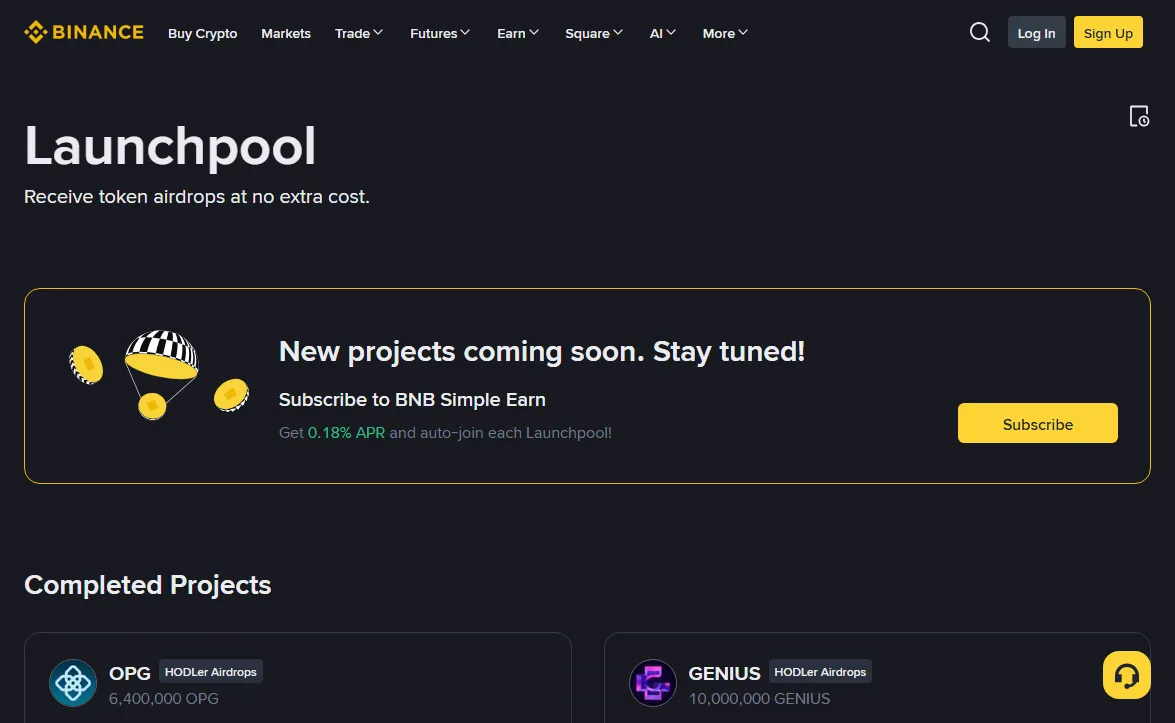
In other words, “Launchpool” has become a section name, and what runs underneath it is snapshot-based distribution. That changes the strategy completely: instead of watching for announcements, the useful question is whether your BNB is sitting somewhere a snapshot will count it.
Where the tokens come from: the project is buying, not the exchange giving
This is the section worth remembering.
Why would a new project hand out tens of millions of tokens? Because it needs two things that are genuinely difficult to buy with money:
- A base of initial holders. A token held only by the team and its investors has a paper-thin order book, moves on a single order, and is a hard sell to any exchange listing committee. Distribute it across hundreds of thousands of addresses and both the float and the holder structure exist overnight.
- A moment of global attention. The campaign appears on the exchange's home page, in its announcements, in its app notifications. That placement is expensive if bought as advertising, assuming the exchange sells it at all.
So the real exchange of value is: the project pays tokens for distribution and holder structure; the exchange pays homepage placement for user retention and assets staying on-platform; you pay the use of your position for a period in return for a quantity of a token whose value is undetermined. Three parties, three motives, no charity anywhere.
Once that is clear, several things stop being mysterious:
- Why these tokens so often fall after listing — a large share of recipients never wanted the token, so the distribution itself manufactures sell pressure.
- Why the advertised numbers always look good — they are computed from a post-listing price, and at the moment of pricing the selling has not finished.
- Why KYC and country exclusions commonly appear — token distribution can carry eligibility and regulatory restrictions beyond an ordinary product yield.
How that headline APR is constructed
The estimated APR on a campaign page is the number everybody remembers and almost nobody interrogates. Its formula is simple, and every term in it has a problem.
Estimated APR ≈ (tokens distributed this period × token unit price) ÷ (total value locked in the pool) × (365 ÷ campaign days)
Problem one: where does that unit price come from?
While the campaign runs, the token does not trade yet. There is no market price. The valuation the exchange displays might come from an over-the-counter expectation, from comparable projects, or be back-filled from the first minutes of trading after listing. None of those is a price you can sell into.
Worse, that price is typically drawn from the moment of least price discovery. In the first hours after listing, the bids are sentiment and the sellers have not all arrived. That window frequently contains the highest price the token ever sees. Compute an APR from it and of course the figure looks handsome.
Problem two: the denominator is live and only grows
When a pool opens, few people are in it, your share is large and the displayed APR is spectacular. As subscriptions arrive, the same numerator is divided among more money and the figure slides. What you see is a value for that second, not a result for your round.
Under the snapshot format the problem changes shape rather than disappearing: the denominator becomes total qualifying BNB across the whole platform, which is neither published nor estimable.
Problem three: multiplying a few days by 365
The most easily skipped layer. A round might last three days. Extrapolating three days of return by a factor of 121.67 into an “annual” rate is arithmetically valid and practically meaningless, because the campaign does not run all year and your share is not repeatable.
The difference between APR and APY, and why extrapolating any current rate is unreliable, is handled in the piece on annualised rates. For now, one sentence is enough: an APR is an instantaneous snapshot projected forward, not a commitment.
So why is it the most prominent number on the page?
Because it is the only figure that produces an urge to act. “You will receive 0.68 tokens” inspires nothing; “estimated APR 340%” is an entirely different sentence, even when both describe the same event. That is not deception — the formula and the basis are usually written into the rules page. It is just that nobody opens the rules page.
Treat it as an order-of-magnitude indicator: three digits means the pool is not full yet or the token valuation is aggressive; two digits means normal territory; single digits means this round is not worth adjusting a position for. Whether it says 340% or 280% is irrelevant, because neither will be realised.
What happens in the first hours of trading
Directly: a freshly listed token has no real market price, only a quote held up by a thin book. That period supplies the input to the advertised APR and is also when most recipients actually sell, which makes it worth understanding on its own.
A token arriving at listing is in an unusual position: it has a large body of holders, almost none of whom acquired it because they wanted it. Three things follow.
- Selling is certain; buying is not. A meaningful fraction of recipients will convert to stablecoins on reflex, and those orders are already sitting there at the open.
- Depth is thin. Only the distributed portion is circulating, so a handful of medium orders can move the price by double digits in either direction.
- Real price discovery takes time. Buyers who hold on fundamentals wait for a narrative, data and liquidity — often weeks or months later.
Put together, they explain the pattern we keep finding in the review data: the price on payout day is usually not the peak, but it is usually higher than the price for a long stretch afterwards. In all four rounds we checked, the token fell from payout day to our snapshot date, by between roughly a quarter and more than half.
That is not a claim that these tokens are doomed; some projects have worked out. It is a claim that “I'll just hold and see” is a bet, and you should know you are placing one rather than treating the balance as banked.
What you actually get depends on when you sell
Once the tokens land, the campaign APR has nothing more to do with you. Only one question remains: when do you sell, and at what price?
- Sell on arrival. You get the market price on distribution day. Historically lower than the campaign-period valuation, but higher than the price for a long time after — that is the shape of our four-round data.
- Wait and see. You are betting the project has something behind it. Some do. Most do not.
- Hold indefinitely. That “yield” has quietly become a position you never decided to open.
The third case deserves a sentence of its own: whatever the airdrop pays you in is exposure you now carry. If you would not have bought the token with money, holding it is absorbing sell pressure on the project's behalf. That angle is developed in which coin the yield is paid in.
The opportunity cost is the real price
“Zero cost” is the most effective phrase in this whole category and the one most in need of a discount. You did not pay anything, but you did give up the following.
- Price exposure. Your BNB has to stay in the account. It rises and falls independently of the campaign, and that movement is yours. If you wanted to reduce during the window and held on for the campaign instead, that is a real cost.
- Conflicting uses. BNB sitting in flexible savings may not be simultaneously available for something else. What stacks and what does not is worked through in can one balance join several programmes at once.
- Operational attention. Classic format needs you to watch windows; snapshot format needs your everyday position to be in the right place. Neither is free.
Add those and the honest description is not zero cost but cost that does not arrive as cash.
Dilution: why the amount always disappoints
Pro-rata allocation is fair. It also has two uncomfortable properties.
First, your share is relative. You did nothing and your position shrank because somebody else added. Popular rounds show this sharply: the announcement lands, capital pours in, and the high APR that early participants saw collapses.
Second, whales are capped, but the cap is high. Recent HODLer Airdrops announcements state a holding cap: where a user's average BNB holding divided by total average holdings exceeds 4%, the ratio is treated as 4%. That prevents one entity from taking most of a pool. For a retail participant it changes nothing — 4% remains an enormous share.
In practice: the honest number is the one Binance publishes as “average airdrop per BNB”. Across the 2026 rounds we reviewed, converting that quantity to dollars puts it in the range of five cents to about thirty cents per BNB. That is a long way from what “hold and get free tokens” suggests.
The full figures, all three pricing bases, and the arithmetic behind each are in four airdrops, reviewed, which took more work than anything else on this site.
What you need in place to qualify
The conditions are similar across formats, and people trip on every one of them:
- Account status. Identity verification must be complete. Announcements typically state that unverified accounts do not count.
- Region. The most-missed condition. Recent announcements list excluded countries and territories; the list is long and it changes. What governs is your account's verification data, not where you physically are.
- What you hold and for how long. Classic format looks at your pool share during the campaign; snapshot format looks at your average balance during the window, usually with a minimum threshold (recently around 0.01 BNB).
- Which account the coins are in. The highest failure rate of the lot. BNB in your spot wallet and BNB in flexible savings are different things to a snapshot. Most people who “definitely had the coins” and got nothing failed right here.
If you don't have an account yet, or you are unsure your balance is in the right place, the full sequence is set out in getting your account ready, with the emphasis on which account actually counts.
Widely repeated claims that don't hold up
“It's free, just join everything”
The first half is true under the snapshot format if you already hold BNB in flexible savings for your own reasons. The moment you change your position to participate — buying, moving funds, giving up another use — it stops being free. The test is simple: if this campaign did not exist, would you do the same thing? Yes means free. No means you have paid.
“Get into the pool early for the high APR”
Slightly true under the classic format, and not worth much. Early entry captures a few hours of inflated rate, but those hours are a small fraction of total emission. What decides your allocation is your average share across the round, not the opening minutes.
“Lots of participants means the project is good”
Participation reflects distribution reach and current sentiment, not project quality. A crowd has exactly one guaranteed effect: your slice is smaller.
“I'll hold it until it recovers”
That sentence assumes the current price is below fair value — a judgement you have done no work to support, since the only reason you hold the token is that it arrived. Dressing “I don't know what to do with this” as “long-term conviction” is the standard psychological trap of this whole category.
“Hundreds of percent, better than any savings product”
Hundreds of percent assumes the campaign runs identically all year. It does not, and you control neither how many rounds you catch nor your share of each. To see the real magnitude you have to return to “how much money per unit held”, which is precisely why we keep a ledger.
So should you take part?
Structurally, if you intend to hold BNB anyway, keeping it in flexible savings rather than idle in the spot wallet costs you almost nothing — you already carry the price exposure, and all you add is product-level risk plus one action. Catching airdrops becomes a by-product of a position you already wanted.
Reverse it and the logic inverts. Buying BNB in order to participate means opening a several-hundred-dollar price exposure to collect something worth cents. A 1% move in BNB exceeds everything the airdrop can give you. That arithmetic is worked through in the price fell while your coins were locked.
Everything above is a dated snapshot. Returns are not guaranteed, none of this is investment advice, and past rounds imply nothing about future ones. Check the current Binance announcement and product page before participating. Crypto prices are volatile and participation can lose you money.
Five things to check first
When a new campaign appears, use this checklist before acting:
- Is this active subscription or a retroactive snapshot? If the latter, has the window already closed?
- Which product does the holding have to be in? Is mine there?
- Has the excluded-region list changed?
- What is the published average per unit held, and roughly what is that worth in money?
- Would I need to buy anything to take part? If so, do I accept that purchase on its own merits?
Five answers and the decision is usually made for you.
Common questions
What is the difference between Launchpool and HODLer Airdrops?
Launchpool is active: you subscribe an asset into a pool during a published window and receive tokens by share and duration, with a live estimated APR visible throughout. HODLer Airdrops are retroactive: Binance takes repeated snapshots of qualifying balances over a past window, then announces and distributes weeks later, so you cannot join after reading about it. Recent completed rounds are mostly the latter.
Can these campaigns lose me money?
The campaign itself normally charges nothing, but you have to hold a specified asset and you carry its price movement. If you buy the asset specifically to take part, a fall in price can cost far more than the airdrop is worth. There is no principal guarantee; the governing terms are whatever the current announcement says.
Is the estimated APR on the campaign page trustworthy?
It is an instantaneous estimate, not a commitment. The token price in the numerator has no real market yet, the pool size in the denominator grows as others join, and projecting a few days out to a year carries a strong assumption. Read it as an order of magnitude, not as expected income.
My coins are in the spot wallet — do they count?
Usually not. HODLer Airdrops announcements generally require the asset to be in Simple Earn or a named on-chain yield product; a plain spot balance is not counted. Each round can define qualifying products differently, so check that round's announcement text.
Why is the amount per BNB so small?
Because allocation is diluted across the whole platform, and both participant numbers and capital are large. Across the four rounds we reviewed, one BNB earned tokens worth roughly five to thirty cents at the payout-day price. The figures and the method are on the review board.
Who is excluded?
Unverified accounts generally do not count, and each announcement lists excluded countries and territories. That list changes with regulation, and eligibility follows your account's verification data. Check the full list in the current announcement before relying on it.