APRLOG / All articles / Do you need to claim Binance Launchpool rewards? Hourly accrual and the 90-minute transfer
Do you need to claim Binance Launchpool rewards? Hourly accrual and the 90-minute transfer
You can leave Binance Launchpool rewards unclaimed. Binance says the accumulated tokens will move to your Spot Account automatically, together with tokens locked directly in Launchpool, within 90 minutes after the locking period ends. Clicking Collect Airdrops during the campaign brings forward the transfer of rewards already earned.
Claiming and earning are separate events. The claim button moves an accrued balance; your share of the pool determines that balance. The details below follow Binance's Launchpool help page, checked on 3 October 2026. The useful question for reconciling a payout is which stage you are looking at: accrual, collection or the final automatic transfer.
Where to claim Launchpool rewards and check their transfer
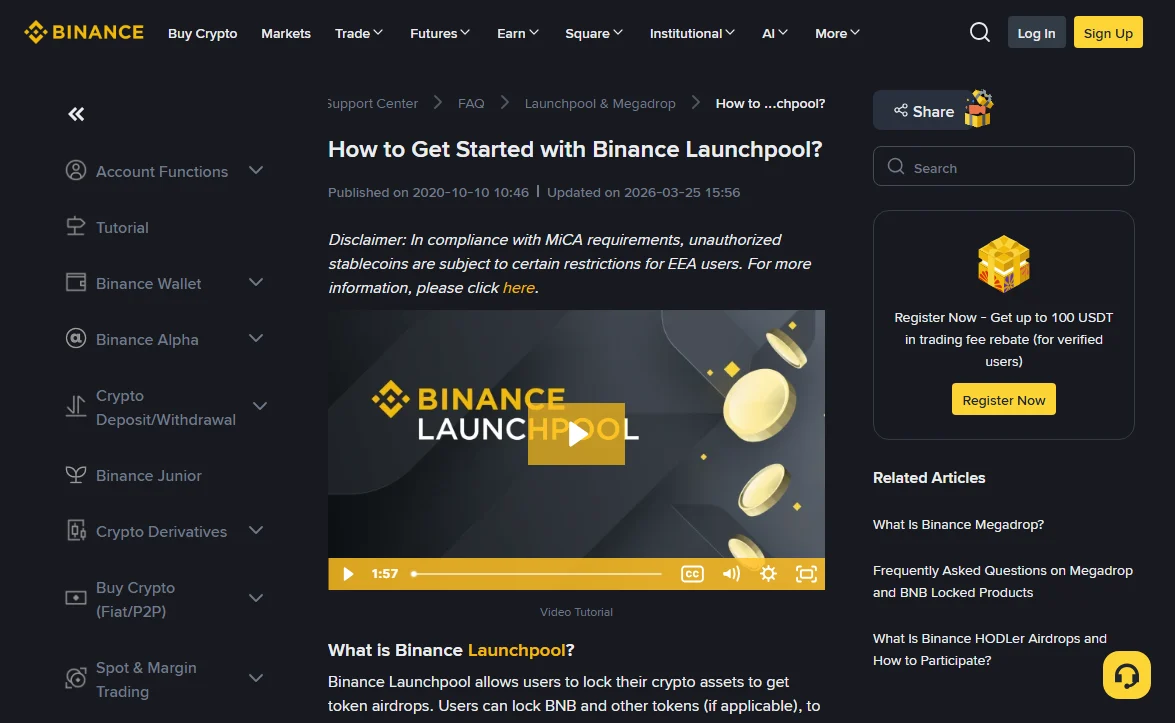
On the project page, look under My Airdrops for the unclaimed token balance. Binance says this figure updates hourly. Use Collect Airdrops to send that balance to your Spot Account, and Launchpool History to check locking and claiming records. These labels come from the public help document; the screenshot below identifies that document, rather than showing a logged-in account.
Leaving that balance alone does not create an expiry deadline at the final minute of farming. Under the published rule, the unclaimed reward balance and assets locked directly in Launchpool are transferred within the following 90 minutes. BNB counted through an Earn product still follows that product's own redemption rules; automatic Launchpool participation should not be read as an instruction to redeem the underlying Earn position.
For the OPN example in the pool-by-pool review, farming ended at 23:59 UTC on 4 March 2026 and trading opened at 13:00 UTC on 5 March. That left roughly thirteen hours between the two events, longer than the stated transfer window. Other campaigns can have different schedules. Holding a reward in Spot before listing also does not make that token tradable before trading opens.
How Launchpool calculates each hour's reward
A fixed balance can earn different quantities in consecutive hours. Binance takes multiple snapshots of your balance and the pool's total during each hour, then uses hourly average balances. If other participants add funds, your share can fall even though you have changed nothing.
For the BNB pool, the help page's formula amounts to:
Hourly reward = your eligible balance ÷ the pool's eligible balance × that day's token allocation ÷ 24
The balance terms depend on those snapshots. Adding funds partway through an hour does not give the added amount a full hour's weight. The final term also refers to the current day's allocation: dividing a whole campaign's reward by its length produces an average, whereas the actual calculation follows the daily allocation and changing pool balances.
The airdrop snapshot guide explains why a balance observed at one moment can differ from an eligible balance. For the wider allocation mechanism and headline annualised rates, see how Launchpool works. Neither a claimed balance nor a displayed annual rate reconstructs your hourly history on its own.
Why a small Launchpool balance may receive no reward
The help page contains two different 0.01 figures. One concerns the asset you supply: the stated minimum lock amount is 0.01 token. The other concerns the reward you earn: when the calculated hourly distribution falls below 0.01, Binance says a reward may not be distributed.
Those quantities can be in different currencies. Locking 0.01 BNB satisfies the stated participation minimum; earning 0.01 OPN in an hour depends on the OPN allocation and your share of the BNB pool. A small eligible balance can therefore participate without producing a visible payout.
The completed OPN campaign gives a historical example, using the 48-hour average figures recorded in the linked pool review. Dividing each average by 48 and solving for a reward of 0.01 gives the estimates below.
| Asset locked | OPN per unit over 48 hours | OPN per unit per hour, averaged | Balance for roughly 0.01 OPN per hour |
|---|---|---|---|
| BNB | 0.9684 | 0.0202 | 0.50 BNB |
| USDC | 0.0011 | 0.000023 | 440 USDC |
| USD1 | 0.0012 | 0.000025 | 400 USD1 |
| U | 0.0022 | 0.000046 | 220 U |
Historical inputs: Binance's completed OPN project figures as recorded in the OPN review, checked there on 16 September 2026; farming ran on 3–4 March 2026. The last two columns are rounded calculations, rechecked on 3 October 2026, rather than published Binance minimums. The BNB formula appears in the help page; the stablecoin estimates apply its separate proportional-allocation explanation.
For example, 0.01 × 48 ÷ 0.9684 gives about 0.50 BNB. At the review's historical two-day average BNB closing price of 645.78 USDT, that rounded balance was worth approximately $320, treating one USDT as one dollar for this illustration. Both the price and the pool average belong to that finished campaign.
The calculation supplies a scale, not an amount to deposit. Hourly balances moved throughout the campaign, and the published averages were already rounded. Binance leaves open what happens to a fraction below 0.01: the help page does not specify whether it carries forward or is discarded. A record showing zero cannot settle that policy question. Use your history to identify the affected hours, then ask Binance support about those entries.
How Earn-held BNB is divided between Launchpool projects
The help page counts BNB held in BNB Flexible Products, Simple Earn Locked Products, On Chain Yield and DeFi BNB towards Launchpool balances. It excludes BNB in Flexible Products pledged as collateral for Binance Loans (Flexible Rate). Where the BNB sits therefore matters before any reward calculation begins.
For multiple ongoing projects, Binance says BNB positions in Simple Earn and DeFi BNB assets in Binance Wallet are split evenly by default. Suppose three projects run together: an equally allocated position contributes one-third to each, rather than its full balance to all three. That can also affect whether a project's hourly reward reaches 0.01.
To change the percentages on the website, use BNB Allocation on the Launchpool homepage. The help page points app users to the adjustment icon on that homepage. Adjustments are available only when multiple projects are upcoming or ongoing. The separate article on using one balance across several programmes covers which programmes can count an asset; allocation here determines how much each Launchpool project counts.
Redemption adds another distinction. The help page says early redemption of a Locked Product can continue earning Launchpool rewards until the assets have fully returned, while noting that this rule may change. During processing, Simple Earn Locked Products and On Chain Yield remain in the calculation; DeFi BNB does not. Any loss of the Earn product's own interest belongs in the early-redemption calculation, separately from the Launchpool payout.
How to compare Launchpool History with a published pool average
Begin with the tokens actually credited to your account. In Launchpool History, identify the project and separate manual claims from the final automatic transfer. An hourly reward balance and the later transfer of that balance describe different stages of the same reward, so adding both together would count it twice.
Next check your eligible balance, the hours it was present, and any allocation to other projects. A campaign-wide average per unit multiplied by your ending balance can only provide a rough comparison. It cannot account for money added midway through farming, withdrawn early or assigned elsewhere.
The payout review board and the OPN review use published averages. To compare your result with an average per unit, you first need a comparable balance and participation period; dividing a total token payout by a per-unit figure alone mixes different units. If the records leave an unexplained gap, keep the project name, timestamps and credited quantities together when requesting clarification.
Which Launchpool rules need checking again for the next campaign?
Binance explicitly allows snapshot timing and the total balance captured in snapshots to vary. Its early-redemption answer also warns that the arrangement can change. Save the date you consulted the help page alongside your account records, and read each campaign's announcement for its assets, schedule and eligibility conditions.
Identity verification and residence in an eligible jurisdiction are required. The English help page read on 3 October 2026 names Canada, Cuba, Crimea, Iran, Japan, the Netherlands, North Korea, the United States and its territories, and non-government-controlled areas of Ukraine as excluded. Binance describes the list as non-exhaustive and subject to change; omission alone cannot confirm eligibility. Check the latest campaign announcement and your account availability.
The 90-minute window explains a transfer rule, not the value of the tokens when they arrive. A reward can reach Spot in full and still be worth less by the time you sell. Keep those two entries separate in your calculation: quantity received first, actual sale proceeds after fees second.