APRLOG / All articles / Getting your account ready before an earn campaign
Getting your account ready before an earn campaign
One common way to arrive here: you spot a campaign, decide to join, click through, and discover it requires BNB held in the account. You check — the coins are definitely there — and the system still says you do not qualify. This walks the whole route in order, and the part that matters is the last step: where the coins have to sit.
Up front: qualifying needs four things true at once — a verified account, a region not on the exclusion list, the required asset at or above the minimum, and that asset inside a recognised product. Most the first three are visible on most checklists. The fourth is easy to miss if you only inspect the account's total balance.
First, work out what this round actually wants
Read the announcement before doing anything; it saves all the wasted effort downstream. Each one usually specifies:
- The qualifying asset. Usually BNB, occasionally a stablecoin or another named token.
- Which product it must sit in. The single most important line — expanded below.
- The qualifying window. Computed live during the campaign, or a snapshot of some past period? If the latter, the window may already have closed by publication. That retroactive mechanism is explained in how “hold and get free tokens” actually works.
- Minimums and caps. Recent announcements typically state a lower bound on holdings and a cap on any single user's share.
- Excluded countries and territories. The list changes; re-read it each round.
Five lines and you know what you are missing. The rest of this fills the gaps in order.
Step one: open the account
Registration itself is trivial — email or phone, a password, a verification step. Two things are worth care.
First, the referral code goes in at registration. The referral relationship is bound at the moment the account is created and generally cannot be added afterwards. If you intend to use one, it has to go into the sign-up form — some entry points collapse it behind a “Referral code (optional)” toggle you have to expand.
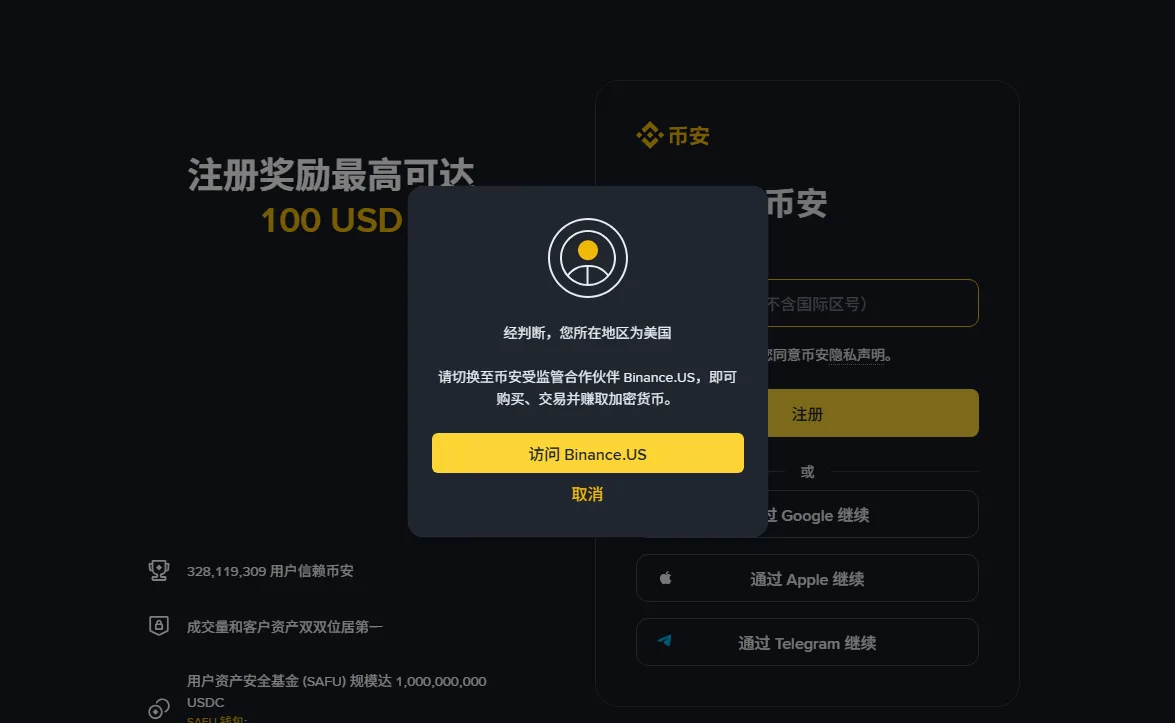
Second, the country or region you select shapes what you can use later. It determines applicable terms, available funding methods, and whether you land on some campaigns' exclusion lists. Changing it afterwards is awkward, so answer it accurately.
About APRLOG's referral code: the code this site uses is BN0112. Opening an account through the link below earns APRLOG a referral commission, paid by Binance out of its own fee revenue, which adds nothing to your costs. The full account is in the affiliate disclosure.
Signing up with a code usually also gives you a trading-fee discount. The rate is not fixed, so this site neither states nor promises a figure — the actual discount is whatever Binance displays when you open the page. Check the terms and the restricted-region list on the platform's official pages yourself.
Registration link: open the Binance sign-up page with code BN0112 applied. This is the only referral link on the site; the official rule pages and announcements cited in the articles carry no code, because they are sources rather than promotion.
Step two: identity verification
Nearly every campaign requires completed verification, and unverified accounts are not counted. Tiers exist; campaigns usually want the basic one, but the announcement governs.
You will generally need an ID document, a selfie or liveness check, and sometimes a proof of address. The places people actually get stuck:
- Document corners cut off. A photo with a corner missing may be sent back. The most frequent rejection by a distance.
- Glare and shadow. Laminated cards photographed under a ceiling light reflect; changing the angle usually fixes it.
- Name spelling must match the document exactly. Middle names and transliteration order are enough to fail it.
- Proof of address has a recency requirement. Commonly a statement from the last three months; older documents are rejected.
I got stuck on proof of address myself and resubmitted twice, because the document was out of date. Review is not usually slow, but starting the day before a campaign closes is a gamble — get verification done early, before you need it.
Step three: funding
How you fund depends on your region and what you already hold. Broadly two routes:
- Transfer crypto in. Most direct if you already hold some. Pick the right network — sending on the wrong chain can lose the asset, and that is worth re-checking however practised you are. A small test transfer first is a good habit.
- Buy with fiat. Available rails, fees and settlement times all vary by region.
If the campaign wants BNB and you hold stablecoins, you will also need a spot conversion. That carries a trading fee, which is proportionally noticeable at small sizes — see where fees eat the yield.
Step four: put the coins where they count (the step that fails)
Directly: coins sitting in your spot wallet effectively do not exist as far as most earn campaigns are concerned. They have to be subscribed into the product the announcement names — usually flexible savings — before anything counts them.
This is the section to remember, and it is the answer to “I definitely have the coins, so why does it say I don't qualify?”
Accounts and products are two different levels
| Location | What it is for | Counted by earn campaigns? |
|---|---|---|
| Spot wallet | Balance available to trade | Usually not |
| Savings product (flexible etc.) | Subscribed and accruing | Usually this is the one |
| Futures / margin account | Leverage and derivatives | Usually not |
| Funding account | P2P and payments | Usually not |
| Self-custody wallet | Assets your keys control | Not for exchange campaigns |
General differences between locations. Which ones a given round recognises is set by that round's announcement — do not carry last round's answer forward.
Why it is designed this way
Part of the point of these campaigns is keeping assets inside yield products. A spot balance can be sold at any second; a subscribed balance is comparatively stable stock. The reward is for the act of putting coins into a product, not for owning the coin. Once that clicks, you stop expecting a spot balance to count.
Moving them in
- Subscription has an effective time. It is not counted the instant you click; accrual rules apply. Retroactive snapshot campaigns weight your average balance over the window, so subscribing near the end produces a low average.
- Flexible can usually be redeemed at any time. But once redeemed, that balance drops out of the calculation. Keeping both flexibility and eligibility is a trade-off you have to make consciously.
- Products can be mutually exclusive. One balance normally occupies one place at a time; see can one balance join several programmes at once.
Step five: confirm you actually qualify
Run this list. Everything ticked means you are genuinely ready:
- Verification shows complete, not “in review”.
- Your registered region is not on this round's exclusion list.
- You hold the asset the announcement names, at or above the minimum.
- That balance is subscribed into the named product and visibly accruing, not sitting in spot.
- For a retroactive campaign, the holding was in place for the whole window, not just one day of it.
- No redemption or transfer in flight that would leave a gap inside the window.
The usual reasons it fails
“I have the coins but it says I don't qualify”
A common cause is location: the balance is in spot rather than a savings product. Open the earn page and confirm it is accruing.
“I redeemed briefly and put it back”
For average-balance campaigns the gap drags your average down. For duration-weighted campaigns it may break accumulation outright.
“Verification completed after the campaign started”
Most announcements require verification at the snapshot moment. Completing it afterwards does nothing for a window that has already passed.
“The referral code never went in”
Referral is bound at account creation and generally cannot be added later. It has no effect on campaign eligibility; it only affects the fee discount.
“The region list changed”
Exclusion lists move with regulation. Eligible last round is not eligible this round; re-read the list every time.
A few closing notes
Security items worth doing on day one: enable two-factor authentication, set a withdrawal address allowlist, keep your login and transaction passwords distinct, and never enter a seed phrase or private key anywhere. None of these are campaign requirements, but an account problem wipes out everything else.
Also: taking part in these campaigns does not require adding money. If a campaign makes you think “I should buy a bit more to make this worthwhile”, stop there — opening a new price exposure to collect something of limited value rarely survives the arithmetic. It is worked through in the price fell while your coins were locked.
Security settings worth doing on day one
Two-factor authentication
Prefer an authenticator app over SMS. SMS codes can be intercepted, and that has happened often enough in this industry to matter. Write the recovery codes down on paper rather than keeping them only on the same phone — losing the phone otherwise loses both at once.
Withdrawal address allowlist
With it on, assets can only leave to addresses you registered in advance, and new addresses usually carry a waiting period. The value is specific: even if someone gets into the account, they cannot send funds to their own address. It is one of the few settings that genuinely backstops you.
Separate your passwords
Login, transaction and email passwords should not match, or be variations of one another. Email is the critical one — most recovery paths run through it, so losing the mailbox is losing the account.
Things never to do
- Never enter a seed phrase or private key on any page. An exchange account does not need either.
- Never follow an “official campaign” link sent by direct message or group chat.
- Never share your screen or install remote-access software at a “support agent's” request. Real support does not ask.
- Never hand API keys to a copy-trading or bot service, especially with withdrawal permission attached.
A troubleshooting order
If you have done everything and are still unsure, check in this order and rule each item out:
| # | Check | Where |
|---|---|---|
| 1 | Verification status reads complete | Account security page |
| 2 | The balance is in a savings product and accruing | Earn positions page |
| 3 | The amount meets this round's minimum | Positions page plus the announcement |
| 4 | Your region is not excluded | The announcement's list |
| 5 | No redemption or transfer inside the window | Account transaction history |
When it is “I had the coins and got nothing”, start with the first two.
If all five pass and you still received nothing, one possibility is that this round's qualifying window closed before you were ready. Retroactive campaigns have no remedy for that; keep the position in place and catch the next one.
A sensible first month
If you are starting from scratch, this sequence is far steadier than reacting to a campaign.
Week one: get the account right, put no money in
- Register, entering a referral code if you intend to use one.
- Complete verification, resubmitting until it reads complete.
- Do the security settings above.
- Deposit nothing. The goal this week is only a usable account.
Week two: run the whole flow with a trivial amount
- Move in an amount you genuinely do not care about. The point is to test the path, not to earn.
- Walk it end to end: deposit, convert, subscribe to flexible savings, then see it accruing on the earn page.
- Check the next day that interest arrived. If it did, the chain works.
- Redeem it again and time how long the money takes to come back. That number is useful later.
People skip this step, and I would not. Running it small once surfaces several details you only learn by doing — an extra confirmation on some transfer, an accrual start that is not when you assumed.
Week three onward: at your own pace
With the path proven, what remains is allocation. That is the point to look at which earn product fits this money, or to read what each earn product costs first and get the structures straight.
Worth repeating: having the account ready is not a reason to put money in it. Preparing an account costs essentially nothing; how much to deposit and into what is a separate decision that should follow your own financial situation, not a feeling that the setup would otherwise go to waste.
This describes a general process. Each campaign's actual requirements are set by the current Binance announcement and product page and can change at any time. Crypto prices are volatile, participation of any kind can lose you money, and nothing here is investment advice.
Common questions
I hold BNB but the campaign says I don't qualify. Why?
Check the location first. A balance sitting in the spot wallet is generally not counted by earn campaigns; it has to be subscribed into the product the announcement names, usually flexible savings. Open the earn page and confirm the balance is accruing there.
Can a referral code be added after registration?
Generally not. The referral relationship is bound when the account is created and cannot usually be applied afterwards. If you intend to use a code, it has to go into the referral field on the sign-up form.
How long does verification take and what do I need?
Typically an ID document, a selfie or liveness check, and sometimes a proof of address. Review times vary. Applications are often sent back for document corners cut off, glare on the photograph, and a proof of address outside the accepted recency window. Do it early rather than when a campaign appears.
Which referral code does APRLOG use?
BN0112. Enter it in the referral field at sign-up; signing up with a code usually gives a trading-fee discount capped at around 20%, and the actual figure is whatever Binance displays. Opening an account through the link in this guide earns APRLOG a referral commission at no extra cost to you, which is set out in the affiliate disclosure.
Does redeeming briefly during the window hurt eligibility?
Yes. Campaigns computed on average balance are dragged down by the gap; duration-weighted campaigns may stop accumulating altogether. Keeping the holding continuous through the whole window is what preserves the allocation.
Which regions are excluded?
Each announcement lists excluded countries and territories, the list changes with regulation, and eligibility follows your account's verification data rather than your physical location. Re-read the current announcement rather than relying on a previous round.