APRLOG / All articles / How Binance Dual Investment settles: the 30-minute Fixing Price and both outcomes for a 1,000-USDT stake
How Binance Dual Investment settles: the 30-minute Fixing Price and both outcomes for a 1,000-USDT stake
Binance settles Dual Investment at 08:00 UTC on the Settlement Date, using the average market price over the preceding half-hour. That single number, compared with your Target Price, decides whether you get your original coin back or a different one. It also differs from the price you would get if you then sold what arrived.
Settlement happens in three steps. The comparison uses the Fixing Price, a 30-minute average rather than the trade printed at 08:00. The reward is the APR scaled to your term, with one rounding step that trims a little off. Then the result goes to your Spot Wallet, with Binance committing to 14:00 UTC at the latest.
Rules and formulas below come from the FAQ on Binance's Dual Investment product page, read on 6 October 2026 and checked again on 8 October. What the product actually is, in options vocabulary, is covered in Dual investment is you selling an option; this piece stays with the mechanics of the settlement moment and the arithmetic.
Which half-hour sets the Dual Investment Fixing Price?
The definition on the page is one line: “Fixing Price: An average of the Market Price in the last 30 minutes before 08:00 (UTC) on the Settlement Date.” The next sentence gives its job: “Fixing Price and Target Price determine whether your investment will be converted into the Target Currency.”
An average is more forgiving than a single print. A sharp wick at 07:58 gets diluted across thirty minutes of prices. The flip side matters just as much: the number on your chart at 08:00 and the number Binance compares may not match, so watching the last minute tells you less than you might expect.
Work out the window in local time once and write it down. In Singapore or Hong Kong (UTC+8, no daylight saving) it runs from 15:30 to 16:00. In New York it falls between 3:30 and 4:00 a.m. while US daylight time is in force, and an hour earlier on the clock after the switch back. UTC never moves; your local reading of it does.
What about a Fixing Price exactly equal to the Target Price? The product page only says “reached”. Binance's Dual Investment tutorial is more precise: Buy Low triggers when the price is at or below the target, Sell High when the price is at or above (checked 6 October 2026). A tie converts.
How Binance rounds Dual Investment rewards down
The formula as printed:
Rewards = Subscription Amount × [APY% × Subscription Period (in days) / 365]
Directly beneath it sits the note that is easy to skim past: the bracketed value “will be rounded down to four decimal places.” Notice too that the formula says APY% while the product list labels the column APR. In practice the number you plug in is the rate shown against the product you picked.
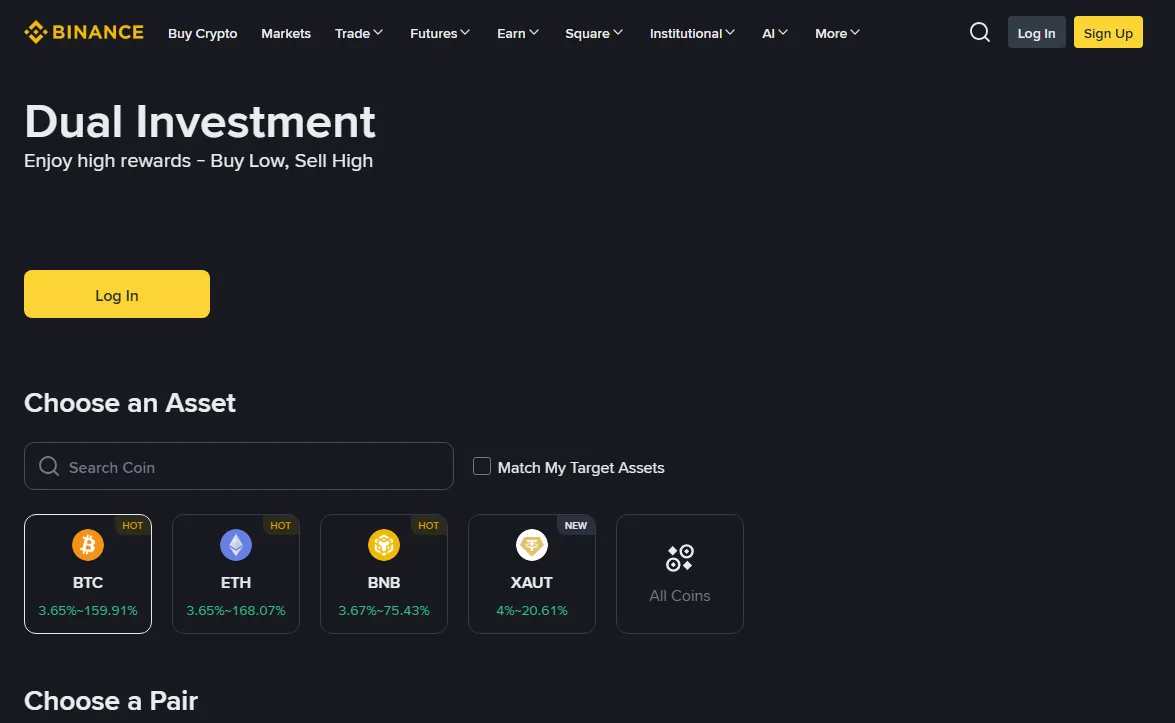
Take a real listing. On 6 October 2026 the page, set to Buy Low for BTC/USDT, showed a Target Price of 85,000 at three different terms: 85.78% for 2 days, 77.78% for 3 days and 73.44% for 4 days. Binance's bitcoin price page that day showed $85,256.34, stamped as last updated 2026/10/5 16:40 (UTC). Every target sat below the market, which is exactly what a Buy Low product is.
Run the 3-day product through the formula. 0.7778 × 3 ÷ 365 = 0.0063928…, rounded down to 0.0063. On a 1,000-USDT subscription the reward is 6.3 USDT.
Convert that back to an annual figure and you get 0.0063 × 365 ÷ 3 = 76.65%, against the advertised 77.78%. The cut is under 0.0001 of the principal for the period, so on this stake it costs less than 0.1 USDT. How much any given product loses depends on the trailing decimals, so neither a short term nor a long one reliably loses more. Among the reasons an advertised rate and the money you receive diverge, this is the one you can verify with a calculator in under a minute.
Buy Low on a 1,000-USDT stake: what you hold after settlement
Same product: Target Price 85,000, 77.78% APR, 3-day term, reward 6.3 USDT. On the Settlement Date only one of these rows applies.
| Fixing Price on the Settlement Date | Binance's formula | You end up holding |
|---|---|---|
| Above 85,000 (target not reached) | Subscription Amount + Rewards | 1,006.3 USDT |
| At or below 85,000 (Buy Low triggered) | (Subscription Amount + Rewards) / Target Price | ≈ 0.01183882 BTC |
Formulas and product terms from Binance's Dual Investment page, checked 6 October 2026. Both results are APRLOG's arithmetic; the BTC figure is shown to eight decimals, with the unrounded value used in later calculations. Selling fees and slippage are excluded.
Read the second row carefully. A triggered Buy Low means the price fell to your target. “Target reached” sounds like success; in this product it only records that the conversion happened. You now hold roughly 0.01183882 BTC bought at 85,000, and its worth in dollars depends on wherever the market sits afterwards.
Sell High mirrors the logic. Miss the target and you get your coin back plus the reward. Hit it and you receive (Subscription Amount + Rewards) × Target Price in the stablecoin, so any rally above the target belongs to someone else.
Converted to BTC: the price where your stake is whole again
Using the unrounded BTC quantity, the price at which your BTC is worth the original 1,000-USDT stake again is about 84,467.85 USDT per BTC: 1,000 ÷ (1,006.3 ÷ 85,000). That is roughly 532.15 below the Target Price, or 0.626% of it.
Be careful what that 532.15 measures: a gap in the price of one bitcoin. Your position itself only ever had 6.3 USDT of cushion above principal, valued at the target.
The Fixing Price decides whether you convert; whether you then lose money depends on the price when you value or sell the BTC. Ignoring fees and slippage, you break even at about 84,467.85 and are underwater below it. If bitcoin trades at 80,000, the BTC you received is worth roughly 947.1 USDT. That is 52.9 short of what you started with and 59.2 short of the untriggered outcome; three days of reward cannot close that gap. The risk banner on the product page puts it bluntly: “You may lose more cryptocurrency than initially subscribed. Subscribed assets are locked until the Settlement Date and subject to market volatility.”
This break-even price holds only when you measure in USDT and before selling costs. It guarantees nothing. If you wanted BTC near 85,000 anyway, a triggered settlement is the result you were after, and counting in USDT is the wrong yardstick for you. How far the verdict shifts when the same position is valued in a different coin is worked through in The price fell while your coins were locked. Did you still gain?
When the settlement lands in your Spot Wallet
The page says Binance calculates returns at 08:00 UTC on the Settlement Date from the Fixing Price and the Target Price, and that “Your returns will be deposited into your Spot Wallet within 6 hours, by 14:00 UTC.” Elsewhere in the same FAQ is a shorter line worth noticing: “The Settlement for tokens are on every workday.”
Translate both times before you plan around them. For a reader in London during British Summer Time, the calculation happens at 09:00 and the deadline is 15:00; in Singapore the window closes at 22:00. To reconcile against Binance's figures, use the entry in your Spot Wallet history alongside the Target Price, Settlement Date and APR shown for that subscription.
On the triggered path, the deposit arrives in a different coin. Your holdings change shape at that moment. Which coin you are paid in usually shapes the yield; with Dual Investment it decides what you own after settlement.
What you cannot change after subscribing
The FAQ is explicit: “Once the subscription is completed, your Target Price, Settlement Date, and APR will be fixed. You are unable to revise these terms once the subscription is completed.” You can review all three under Earn Wallet and Earn History, but they stay as they are. Binance's tutorial adds that subscribed assets are locked until the Settlement Date and cannot be cancelled or redeemed before it.
So the decision that matters is made before you press Subscribe, not on the Settlement Date. Two questions are worth answering first: how far the target sits from the current price, and whether you would accept being converted at that distance; and, if conversion happens, what you plan to do with the coin you receive.
Whether the product is offered to you at all depends on the jurisdiction your account is registered in, so check while logged in rather than assuming. And where the English and translated FAQs disagree, Binance states that the English page at binance.com/en/dual-investment prevails, which makes it the one to compare against when figures look off.
Terms quoted here come from Binance's Dual Investment page as read on 6 and 8 October 2026. The amounts and the break-even price before trading costs are APRLOG's calculations from the published formula, not figures Binance publishes. Targets, rates and Settlement Dates change daily and the page rules can be revised, so rely on the terms shown at the moment you subscribe. This article explains how settlement works; it makes no promise about any product's return.
Questions
Does Binance Dual Investment settle on the last traded price at expiry?
No. The product page calls the settlement reference the Fixing Price and defines it as the average market price in the last 30 minutes before 08:00 UTC on the Settlement Date. That window is 07:30–08:00 UTC; convert it to your own time zone, remembering that daylight-saving changes move the local clock time but leave the UTC time fixed. Checked on 6 October 2026 and again on 8 October 2026.
Why is my Dual Investment reward slightly smaller than the APR suggests?
Binance multiplies the subscription amount by the APY% times the subscription period in days divided by 365, and rounds that bracketed figure down to four decimal places. For a 3-day product at 77.78%, 0.7778 × 3 ÷ 365 is 0.0063928…, which becomes 0.0063. A 1,000-USDT subscription then earns 6.3 USDT, equivalent to 76.65% a year. How much the rounding removes depends on the decimals of each calculation, so a shorter term does not automatically lose more. The formula is Binance's; the figures are APRLOG's arithmetic.
When does Binance Dual Investment pay out, and into which wallet?
Binance calculates returns at 08:00 UTC on the Settlement Date and says they are deposited into your Spot Wallet within 6 hours, by 14:00 UTC. The page also states that token settlement takes place on every workday. Checked on 6 October 2026 and again on 8 October 2026.