APRLOG / All articles / Flexible, locked, dual investment, staking: what each one costs
Flexible, locked, dual investment, staking: what each one costs
Open an exchange's earn page and you get a column of options — flexible, locked, dual investment, staking — each with a percentage beside it. Most people pick the biggest number. The argument of this article is that those percentages are not measured on the same scale, so comparing them is like comparing apples with an exchange rate.
The short version: these four earn their return in completely different ways. Flexible and locked products earn a lending spread. Staking earns protocol block rewards. Dual investment does not earn interest at all — it earns an option premium. Their percentages are not comparable because what you are carrying is not the same thing.
Start with the comparison
| Dimension | Flexible | Locked | Dual investment | Staking |
|---|---|---|---|---|
| Source of return | Borrowing demand | Borrowing demand | Option premium | Block rewards |
| Principal denominated in | The original asset | The original asset | May settle in a different asset | The original asset |
| Withdraw at any time? | Usually | No, or at a cost | No, locked to settlement | Unbonding period applies |
| Rate fixed? | Floating, changes daily | Fixed at subscription | Fixed at subscription | Floats with the network |
| Worst realistic case | Rate falls near zero | You need the cash and can't get it | You end up holding the asset you didn't want | You cannot exit during unbonding |
| Primary risk layer | Platform | Platform | Market + platform | Protocol + platform |
Structural differences. Actual terms vary by product; the rules on your own subscription page govern.
Flexible: instant access, at the price of never setting the rate
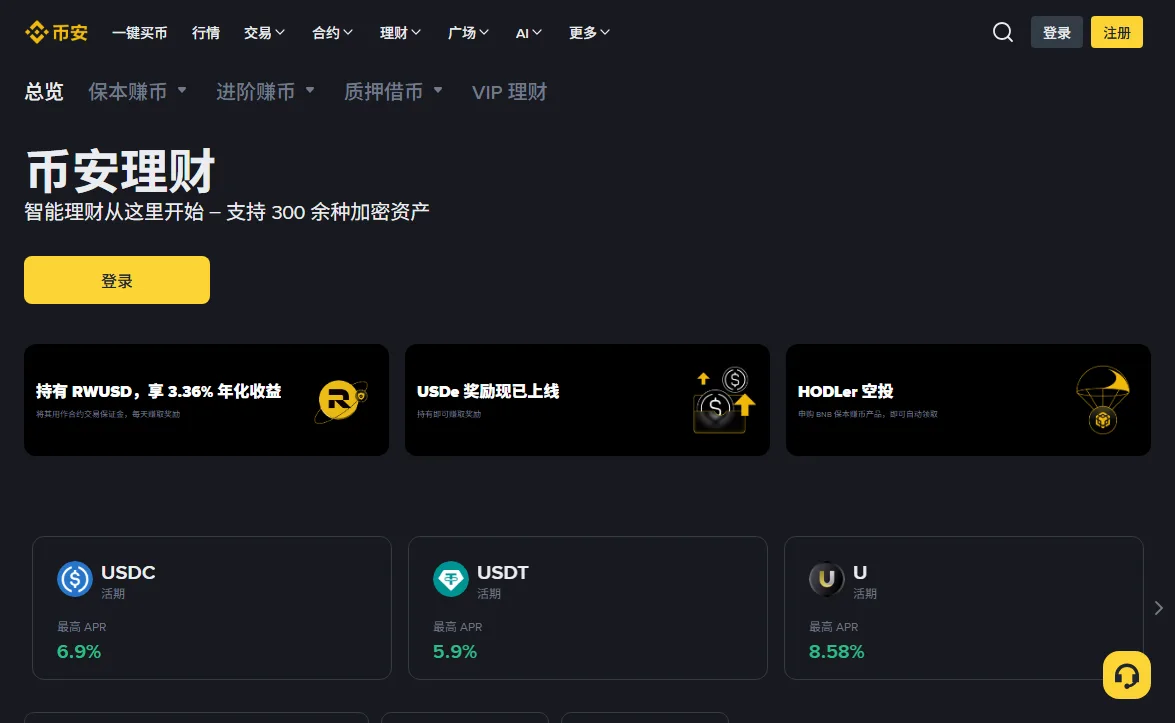
The lowest-friction option: deposit, withdraw whenever, accrue daily. The return comes from the platform lending your balance to traders who want leverage, and keeping part of the spread.
What you are carrying:
- A fully floating rate. Six per cent today can be two per cent tomorrow. It tracks the borrowing market and nothing is locked for you. In quiet markets, stablecoin flexible rates falling to very little is normal.
- Tiered rates. Many flexible products do not apply one rate to your whole balance; the first slice earns the headline rate and everything above it earns considerably less. See a large number, deposit a large amount, and most of it earns the lower tier. Taken apart in why flexible rates move every day.
- Platform-layer risk. The balance is on the platform's books, not in a wallet you control. Every exchange earn product shares this, independent of which product it is.
When flexible is the wrong choice
If your objective is “this money has a job in twelve months and I need to know how much there will be”, flexible cannot give you that certainty. It suits money that might be needed at any moment, and suits nothing that requires a projected end value.
Locked: what you are selling is liquidity
Locked products fix the rate at subscription in exchange for the money being unavailable until maturity. As a piece of pricing it is very clean: you sold the right to withdraw on demand, and the platform paid you a little extra rate for it.
Things to look at:
- Early redemption is handled in more than one way. Three are common: forfeit all accrued interest, recompute at the flexible rate, or no early exit at all. The gap between them is wide and it is set per product. What early redemption costs you lists the lines to find before subscribing.
- Accrual start and end dates matter. Whether the subscription day and the redemption day accrue differs by product. The shorter the term, the more those one or two days distort the realised rate.
- Verify auto-renewal for this subscription. If enabled, maturity rolls into a new term at a possibly different rate. Do not assume the state from another product; see how auto-renewal quietly locks you in.
When locked is the wrong choice
If there is a realistic chance you will want to adjust the position during the term, and this money is a meaningful share of your holdings, then the lock itself is the risk. The extra spread rarely compensates for one occasion of wanting to act and being unable to.
Dual investment: this is not savings, it is selling an option
Directly: the high return on dual investment is not interest, it is an option premium. At the moment you subscribe you have sold an option — a commitment to buy or sell an asset at a stated price. The money you receive is what the buyer paid for that commitment, not a distribution from the platform.
This is the section the article exists for. Practically all coverage frames dual investment as a high-yield savings product, and that framing guarantees you will not understand what happened on settlement day.
How it actually works
Take the common case. Say BTC is at 100,000. You choose a product with a settlement price of 110,000 and a seven-day term, subscribing with BTC. The rules are:
- If BTC at expiry has not reached 110,000: you get your BTC back plus the stated return.
- If BTC at expiry is above 110,000: your BTC is converted to USDT at 110,000, plus the stated return.
Restated in options language, in one sentence: you sold a covered call on BTC, strike 110,000, seven days, and the “return” is the premium.
If instead you subscribe with USDT and agree to buy at a lower price, you have sold a put. The logic is symmetric.
Why you feel wrong whichever way it goes
This is the most counter-intuitive part. Lay both outcomes out:
| Market direction | Settlement | How it feels | What actually happened |
|---|---|---|---|
| Price stays below strike | Original asset + return | “I was locked up through a rally” | The option expired; you kept the whole premium |
| Price passes the strike | Converted + return | “My coins were sold cheap” | The option was exercised at the price you agreed |
Two settlement paths. The return is fixed; the cost is giving up the upside beyond the strike.
The root of it: an option seller's upside is capped at the premium while the exposure is asymmetric. Sideways markets pay you the premium; a strong move through your strike leaves you delivering at the agreed price with the excess gone. Feeling wrong either way is not bad luck, it is the structure.
Where the high APR comes from
Premium is driven mainly by volatility. The more turbulent the market, the more buyers will pay, and the more the seller collects. So triple-digit figures usually mean one of two things:
- Volatility is elevated and options are broadly expensive;
- Your strike sits very close to spot, so exercise is highly likely.
Be careful of the second. A strike hugging spot produces a beautiful APR that essentially means “you will almost certainly be converted”. At that point the percentage is less a return than compensation for the conversion.
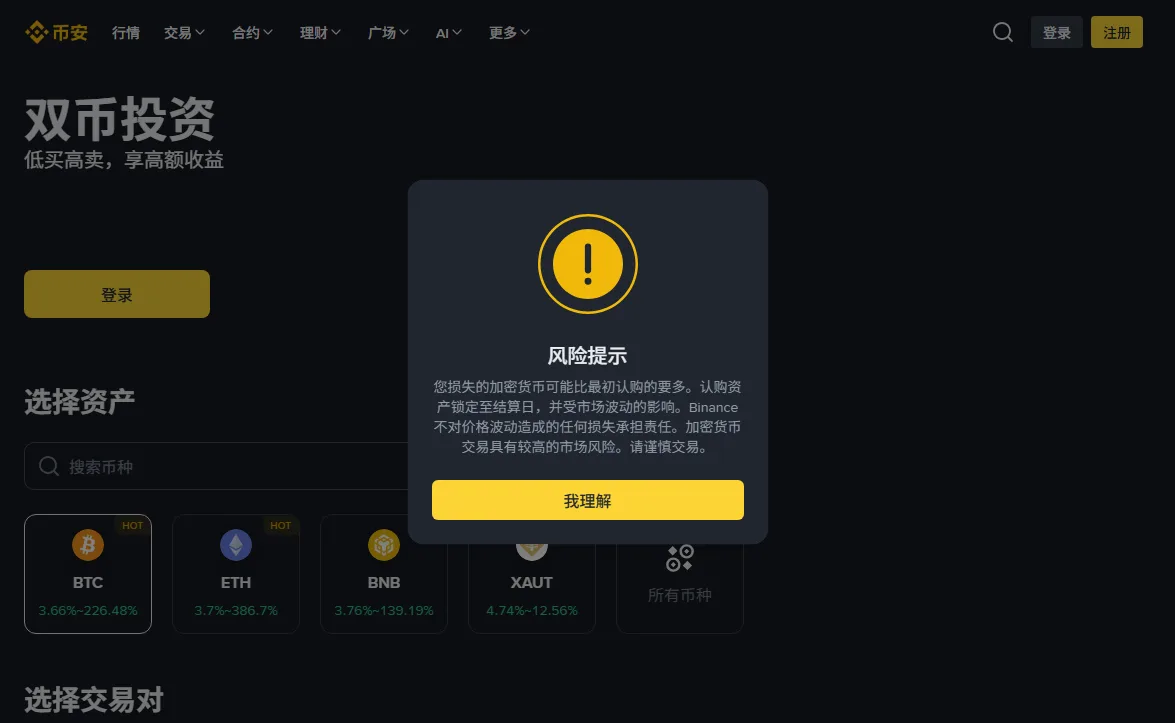
The Binance dual investment page carries its own risk notice, to the effect that you may lose more crypto than you initially subscribed, that subscribed assets are locked until settlement and subject to market movement, and that the platform accepts no liability for losses caused by price changes. That is the sense of the official wording, not our characterisation — a genuine deposit product would not need to say it.
Putting numbers on it
The following is a hypothetical worked example, not a quote for any real product. Round numbers for readability.
You hold 1 BTC at 100,000. You subscribe to a seven-day product, strike 110,000, period return 1%. Three outcomes at expiry:
| Price at expiry | You receive | In dollars | Versus doing nothing |
|---|---|---|---|
| 90,000 (down) | 1.01 BTC | 90,900 | +900, but you took the whole fall |
| 105,000 (up, no exercise) | 1.01 BTC | 106,050 | +1,050 — the comfortable case |
| 130,000 (up, exercised) | 111,100 USDT | 111,100 | −18,900 of upside you don't get |
Hypothetical illustration of structure only. It represents no real product's terms or returns.
The table makes the position plain: your upside is nailed to that 1%, you absorbed the entire downside, and the large rally passed you by. That is the standard position of an option seller — narrow wins, frequent; wide losses, rare.
So the real question before subscribing is not “what is the APR” but “at this strike, would I have been happy to sell anyway?” If yes, the premium is free money. If no, you are promising to do something you don't want to do, for one per cent.
When dual investment is the wrong choice
If you care which asset you end up holding, this product is not for you, because you do not choose the settlement currency. It fits when you already intended to sell (or buy) at some level. Dual investment is you selling an option draws the payoff and works through who it suits.
Staking: the risk moves to a different floor
The first three sit mostly on platform risk. Staking does not — it exposes you to the protocol layer, which is a different category of thing entirely.
The return comes from the blockchain itself: you, or a validator acting for you, participate in consensus and the network issues rewards by rule. That money is minted by the protocol, not paid by a company.
What you carry:
- The unbonding period. The most underestimated item. Exiting a stake means queueing, for a duration the protocol sets and no platform can shorten. Ethereum's exit queue lengthens noticeably when the network is busy. During it you can neither use the asset nor sell it.
- Validator-level penalties. A validator that goes offline or misbehaves can trigger protocol penalties. Who stakes on your behalf is therefore a substantive question.
- Liquid staking tokens are a different instrument. Some products hand you a tradable receipt so you keep liquidity while staked. The receipt's price is set by the market and can trade at a discount to the underlying, and the discount widens exactly when markets are stressed. Treating it as equal to the underlying is a common mistake.
- Custodial versus non-custodial. Staking through an exchange leaves the asset with the platform; running your own or using a non-custodial route has a different risk shape entirely. Staking ETH vs exchange savings compares the routes.
When staking is the wrong choice
If you need to be able to exit fully within a few days, staking does not fit. The unbonding period is a protocol rule, not something support can waive.
Reading a category name like “principal protected”
Exchange earn pages group products into categories, and one of them tends to carry a name along the lines of principal-protected or capital-protected. The label invites a specific misunderstanding.
What it means is that the quantity of the asset you deposited will not be reduced by the product mechanism — put in 1 BNB and you get 1 BNB plus interest. What it does not, and cannot, promise is what that 1 BNB is worth.
In other words, the protection covers the coin count, not the money. BNB falling from 700 dollars to 500 leaves your principal at exactly 1 BNB, with the terms honoured in full, and your account materially smaller in dollars. That denomination gap is the single most common misreading in crypto savings; what “principal protected” actually protects is about nothing else.
When the yield arrives, and in what
The detail most easily skipped at selection time, and most keenly felt afterwards. Two products at 5% can hand you quite different things.
Payment frequency
Flexible usually settles daily and shows up the next day; locked often pays in a lump at maturity, though daily variants exist; staking rewards follow the protocol's cadence and platforms may batch them daily or weekly; dual investment pays once at settlement.
Frequency matters through compounding: a product that pays daily and auto-reinvests realises slightly more than its nominal rate, while a lump at maturity realises exactly the nominal rate. That is the APR/APY distinction, worked out in the piece on annualised rates.
Which asset it pays in
Far more consequential than frequency. Three common cases:
- Paid in the same asset. Deposit BNB, receive BNB. Effectively you are adding to your BNB position; the exposure grows.
- Paid in a stablecoin. Deposit BNB, receive USDT. Effectively you bank the yield continuously; the exposure stays put.
- Paid in a third token. Some campaign products pay in something you never intended to hold. The “APR” is then denominated in that token, and moves with its price.
The third deserves suspicion. A product advertising 30% that pays in an illiquid small-cap is closer to a lottery ticket than to interest; where the risk hides in high-APR products takes the sources apart.
Classifying products you have not seen before
New names appear on earn pages regularly. Rather than memorising each, three questions will sort any of them into a row of the table above:
- Where does the return come from? Lending spread, option premium, protocol reward, or a project subsidy? That fixes the risk category.
- Can the principal turn into something else? Yes means there is an option or a conversion clause in there. No means it is debt-like.
- When can I get it back? On demand, at maturity, or after a queue? That is the liquidity cost.
Three answers and the new name has a home. Conversely, if a product page leaves any of the three unanswerable, that is itself a reason to stop.
The risk layer all four share
Everything above is about differences. One risk is common to all of them and is invisible in any rate table: the asset sits on the platform's books.
That does not mean “the platform will abscond”, which is a lazy formulation. It means something more concrete:
- What you hold is an entry in the platform's ledger, not an asset your keys control;
- The ability to pay ultimately depends on the platform's own balance sheet, which you cannot independently verify;
- Under extreme conditions, redemption and withdrawal can be delayed — this has happened in the industry more than once;
- Regulatory change can stop a product being offered in your region, and then the exit timing is not yours.
Quantifying that is unrealistic, but holding it in mind changes how you allocate: a slightly higher rate is not a reason to put a larger share of your assets on one platform. The value of spreading is not extra return, it is that no single failure reaches your foundation.
The lines worth reading before you subscribe
Product pages vary wildly in length, but the information that changes the outcome is usually five lines. Find these first; if they are missing, do not let the displayed rate answer in their place:
- What the principal is denominated in, and what asset comes back at maturity. This decides what “protected” means for you.
- Exactly how early exit is handled. Forfeit interest, recompute at flexible, or no exit.
- Accrual start and end rules. Especially on short terms.
- Whether auto-renewal is on, and where to turn it off. Frequently on by default.
- Whether the rate is tiered. Does the displayed figure apply to the whole balance or only the first slice?
Find those five and you understand the product better than most people buying it. The APR turns out to be the least important line on the page.
Comparing the four honestly
If only one thing survives from this article, let it be: before comparing yields, confirm you are comparing the same kind of thing.
A 5% flexible product and a 5% dual investment look identical and are not. In the first you carry platform risk and rate movement. In the second you sold an option and carry conversion risk. Those are not the same five per cent.
A more useful sequence is to ask yourself:
- How long am I certain not to need this? Decides whether locked and staking are even candidates.
- Can I accept ending up with a different asset? Decides dual investment.
- Do I want more coins or banked money? Decides whether same-asset or stablecoin payouts suit, per which coin the yield is paid in.
- Am I willing to take protocol-layer risk? Decides staking.
Four answers usually leave one or two options standing. If you would like the process mechanised, which earn product fits this money turns those questions into buttons and attaches the cost to every result.
Two practical boundaries
First, nothing with a lock-up should exceed the portion of funds you have already committed to leaving alone. The costly case is often not a lower rate but being unable to act when you need to reduce a position or use the money.
Second, with dual investment: do not treat it as ordinary savings until you can explain both settlement paths in options language. Buying it as savings invites emotional action at settlement — chasing the asset after conversion, or increasing the size after no conversion. Both can turn the product risk into a new trading risk.
This article discusses product structure and is not investment advice. No return here is guaranteed and no principal is protected in value terms. Platform figures are dated snapshots; the rules on your subscription page and the current announcement govern. Crypto prices are volatile and any of these products can lose you money.
Common questions
How is dual investment different from ordinary savings?
Ordinary savings earn a lending spread; principal is denominated in the deposited asset and the same asset comes back. Dual investment earns an option premium: you sold an option at subscription, and at expiry you may receive the original asset or be converted into another at the agreed price. You do not choose the settlement asset, which is the fundamental difference.
Does a “principal protected” label mean I cannot lose money?
It means the quantity of the deposited asset is not reduced by the product mechanism. It does not mean the fiat value of that asset will not fall. You continue to carry the price movement of whatever you deposited. The product page's risk section is the governing text.
How much extra rate justifies locking money up?
There is no universal figure, because it depends on the probability you will want the money during the term. A workable approach is to first decide how long the money is genuinely idle, then buy only terms within that horizon — rather than starting from the rate difference and backing into a term.
How long does unbonding staked ETH take?
It is set by Ethereum's exit queue and lengthens when the network is busy; no platform can accelerate it. Check the redemption timing stated on the product you use, and plan around that period as genuinely unavailable.
Why can dual investment show triple-digit APR?
Option premium is driven largely by volatility, and by how close the strike sits to spot. The highest APR tiers usually mean conversion is very likely, so the figure is closer to compensation for being converted than to a return you can repeat.
Can the same balance be used in several of these at once?
Generally not. One balance normally occupies one product at a time, and some products are mutually exclusive on top of that. Which combinations stack depends on the specific product descriptions.