APRLOG / All articles / Dual investment is you selling an option
Dual investment is you selling an option
The dual investment page says something like “buy low, sell high, earn a high return”. That is not false, but it describes one possible outcome, not the mechanism. To understand what you are buying you need a different vocabulary — the vocabulary of options.
Directly: the moment you subscribe, you have sold an option. The “return” is the premium the buyer paid you. What you gave in exchange is an obligation — to buy or sell an asset at a stated price. This is an options trade wearing a savings-product interface.
Two products, two options
Subscribe with the asset: selling a call
You hold BTC, pick a settlement price above spot and an expiry. At expiry:
- Price below the settlement price: you get the BTC back plus the return.
- Price above it: your BTC converts to USDT at that price, plus the return.
That is a covered call: you hold the underlying, sell a call against it, collect the premium, and give up everything above the strike.
Subscribe with stablecoins: selling a put
You hold USDT and pick a settlement price below spot. At expiry:
- Price above it: USDT back plus the return.
- Price below it: your USDT converts to BTC at that price, plus the return.
A cash-secured put: capital set aside, put sold, and the cost is potentially taking delivery into a falling market.
The two settlement paths, drawn
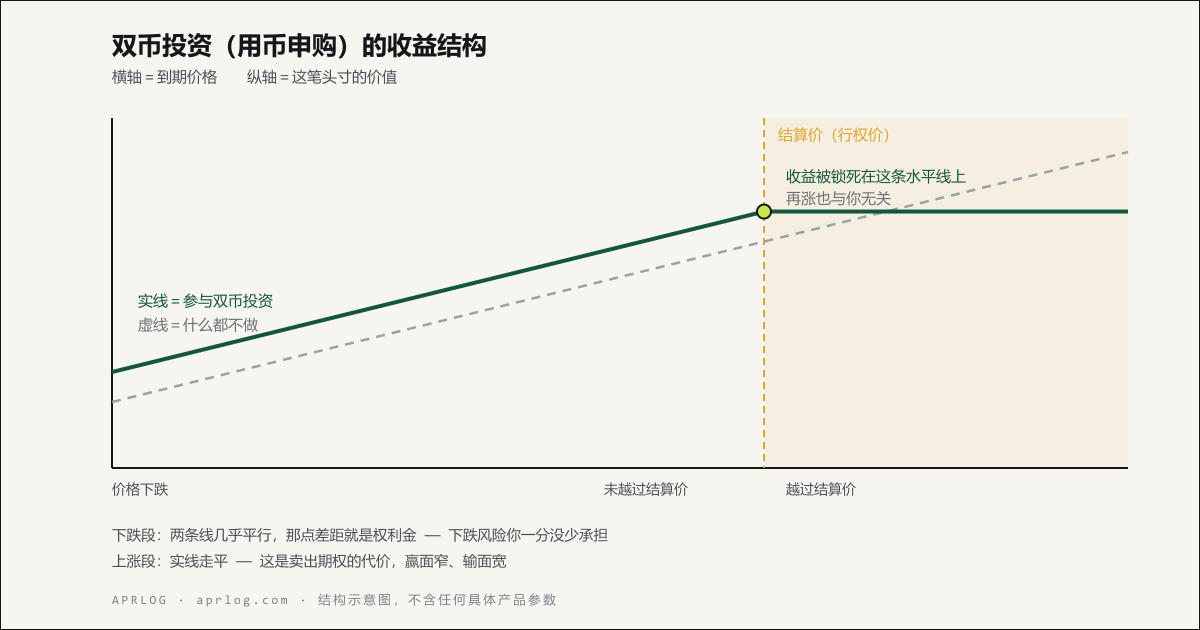
Three regions matter:
- Left, price falling: the lines run almost parallel, the solid one slightly higher. That gap is the premium. You absorbed the entire downside.
- Middle, small moves: the solid line is above the dashed one. This is the only region where you are genuinely ahead.
- Right, large rally: the solid line flattens. Your return is nailed to the premium and the further it rises the more you forgo.
The option seller's whole situation is in that shape: narrow wins that happen often, wide losses that happen rarely. Over time the strategy contributes steadily in choppy markets and underperforms persistently in a one-way rally.
Why it always feels like the wrong call
| Outcome | You receive | First reaction | What actually happened |
|---|---|---|---|
| Not exercised | Asset + premium | “There was a rally and I was locked up” | The option expired; the premium is entirely yours |
| Exercised | Other asset + premium | “My coins were sold cheap” | Delivered at the price you agreed to |
Both paths, with the emotional reading beside them. Note the last column — you agreed to both outcomes at subscription.
The discomfort is not the product cheating you. It is that this product requires you to commit in advance, while human preferences move. You agreed at 100,000 to sell at 110,000; by the time it reaches 130,000 you no longer want to. The product did not change. You did.
What the high APR is compensating for
Premium is set mainly by three things:
- Volatility. Turbulent markets make options expensive and sellers well paid.
- Distance from strike to spot. Closer means more likely exercise and a higher premium.
- Time to expiry. Longer carries more uncertainty and a bigger premium, though not necessarily a bigger annualised figure.
So a triple-digit tier usually means the second: the strike is hugging spot and you will almost certainly be converted. That percentage is better understood as compensation for the conversion — “I will very likely transact at this level and the platform is paying me a little extra for committing”.
Who it suits
There are legitimate uses, provided your intention matches the structure:
- You already meant to reduce at some level. Selling a call at that level earns a premium a limit order would not. This is the cleanest use.
- You already meant to add at some level. Sell a put there; symmetric logic.
- You expect a choppy market. Chop is the option seller's home ground — but that is a directional judgement, not a free lunch.
Equally clear is who it does not suit: anyone with a strong requirement about which asset they end up holding, anyone chasing the APR without looking at the strike, and anyone who needs the capital liquid before expiry.
How the platform describes the risk
The Binance dual investment page carries a risk notice to the effect that you may lose more crypto than you initially subscribed, that subscribed assets are locked until settlement and exposed to market movement, and that the platform bears no liability for losses from price changes.
Read that sentence carefully. A genuine term-deposit product does not need to warn that losses may exceed the subscription. The official wording already characterises the product accurately; it is simply overshadowed by the “buy low, sell high” banner above it.
What to do after being converted
The step most often mishandled. Say your BTC converted at 110,000 and the market is now 130,000. Both instinctive reactions are poor:
- Buy it back at 130,000. You have paid twenty thousand more for the same asset, turning a planned reduction into a chase.
- Sell a put to get back in lower. If the rally continues you never fill, and the capital stays occupied throughout.
The disciplined move is to treat the conversion as a completed reduction you consented to, then make a fresh independent decision: at today's price, do I want to buy? If not, do not. Where you sold has nothing to do with it.
Compared with simply placing a limit order
If you already intend to sell at a level, you have two routes: a limit sell, or a dual investment. The objectives look identical and the mechanics are not.
| Limit sell order | Dual investment (selling a call) | |
|---|---|---|
| If the price gets there | Fills, you hold cash | Converts at settlement, plus premium |
| If it does not | Order rests, you keep the asset | Asset back, plus premium |
| Extra income | None | The premium |
| Cancellable? | Yes, any time | Usually not; locked to settlement |
| What triggers it | Any touch of the price | Only the price at settlement |
| Spikes then retraces | Fills | Does not fill — you miss it |
The last two rows are the substantive difference and the most easily overlooked.
Expand that final row. Your target is 110,000; the market touches 115,000 and falls back to 100,000:
- Limit order: filled at 110,000, objective achieved.
- Dual investment: settlement price is 100,000, below strike, so you keep the asset plus premium — objective missed, and the asset is lower.
That is European-style settlement: only the moment of expiry counts, not the path taken. The extra premium is, in part, payment for accepting that disadvantage.
Conversely, if the market grinds up and finishes above the strike, dual investment beats the limit order — same execution price, plus a premium. So the choice depends on your view of the path: a steady climb favours dual investment; violent swings favour the limit order. That is itself a directional call; neither option is risk-free.
Why the premium moves, and when it gets expensive
Same asset, same tenor, and the yield differs from last week — sometimes by a multiple. The platform is not adjusting anything; option pricing is.
The dominant input is implied volatility, the market's expectation of future movement. High implied volatility means buyers pay more and sellers collect more. When is it high?
- Just after a violent move. The market has been frightened and uncertainty about what comes next is at its peak.
- Ahead of a scheduled event. A known date pulls option prices up beforehand.
- When liquidity is stressed. Fewer willing sellers means a higher price.
Conversely, in a long quiet range the premium is thin and dual investment yields look uninteresting.
There is an uncomfortable corollary here: the moment dual investment looks most attractive is usually the moment the market is least certain. A high premium is not free money falling from the sky; it is the price of the larger swing you are about to underwrite. When the yield suddenly becomes tempting, the right first question is “what just happened?”, not “this one's worth it”.
Three common ways to use it badly
One: sorting by APR without looking at the strike
Sorting the product list by yield and taking the top row is both the most common approach and the most dangerous, because the highest yield is almost always the strike nearest spot — meaning conversion is close to certain.
The correct order is strike first. Ask whether you would be content transacting at that price; if yes, then look at what yield it carries. The yield is a consequence of choosing a strike, not the starting point.
Two: chasing the asset back after conversion
Mentioned above, repeated here because it does the most damage. Converted to USDT, market keeps climbing, and the urge to buy back higher is strong. That round trip turns a planned reduction into buying the top.
Three: running it as a rolling income strategy
A few successful rounds, so more capital goes in, and it becomes a continuous cycle. In a range-bound market this prints money and looks extremely stable — which is precisely the danger.
An option seller's return profile is frequent small gains and occasional large losses. A run of wins means the one-way move has not arrived yet, not that the strategy is low risk. Professional sellers survive on position sizing, not on streaks.
If you notice most of your capital has drifted into this cycle, the exposure is probably well beyond what you intended. That is a good moment to reread the relevant row of the risk and liquidity table.
This discusses product structure and is not investment advice. Dual investment does not protect principal, you do not choose the settlement asset, and you may take delivery of a depreciating asset. The rules on your subscription page govern.
Common questions
Is dual investment a savings product?
Structurally it is an options trade rather than a deposit. Subscribing sells an option; the return is the premium and the cost is an obligation to transact at an agreed price. Which asset you hold at expiry is not your choice.
Why can the APR reach triple digits?
Premium is driven by volatility and by how close the strike sits to spot. Triple-digit tiers usually mean the strike is very close, so conversion is highly likely. The figure is closer to compensation for conversion than to a repeatable yield.
What should I do after being converted?
The disciplined approach is to treat it as a completed transaction you consented to, then decide independently whether you want to buy at today's price. Buying straight back higher converts a planned reduction into chasing the market.
Who is dual investment actually suitable for?
Someone who already intended to reduce or add at a specific level and can collect a premium for committing to it. It is unsuitable if you care which asset you end up with, or if the APR attracted you without your having examined the strike.