APRLOG / All articles / Binance RWUSD 3.61% APR: redemption fees, T+3, what you keep
Binance RWUSD 3.61% APR: redemption fees, T+3, what you keep
On this page (6 sections)
- When RWUSD starts and stops earning
- How many days of yield the 0.05% and 0.1% redemption fees eat
- Standard redemption takes T+3, and those days earn nothing
- You get USDC back, not USDT: selling on spot instead
- RWUSD vs USDT Flexible on 8 November 2026: which paid more
- Is RWUSD principal-protected? What the FAQ says
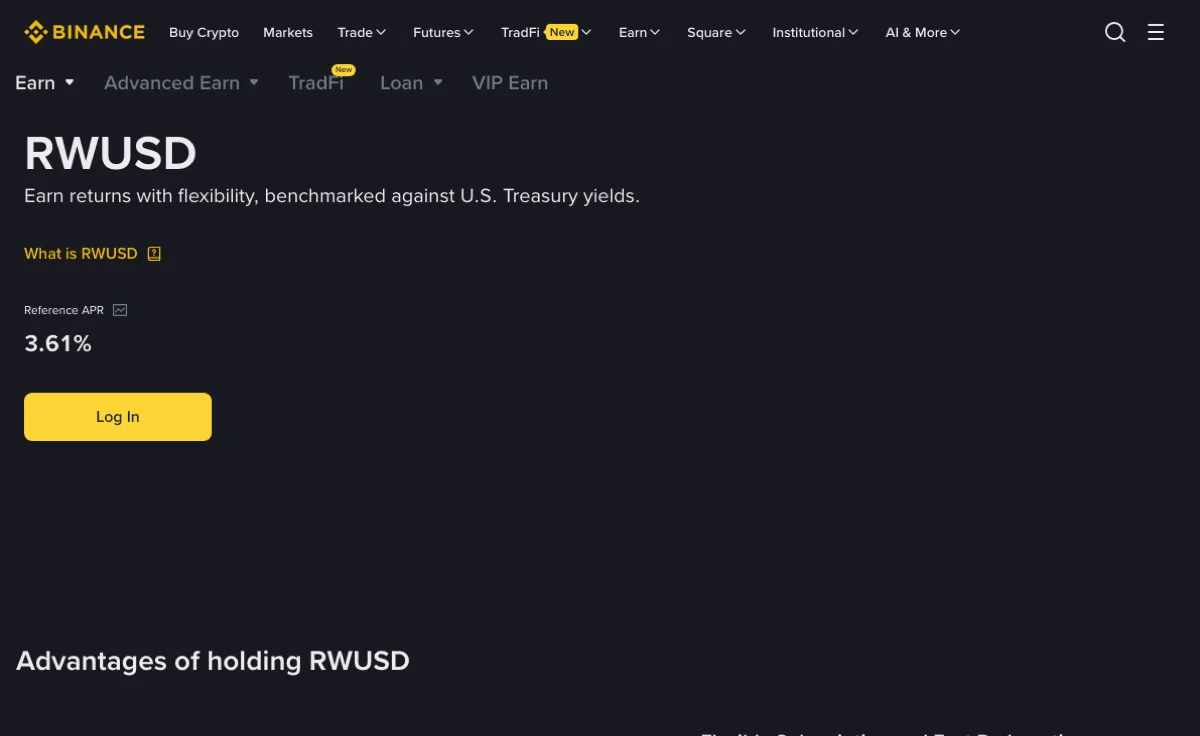
On 8 November 2026 Binance's RWUSD product page showed a reference APR of 3.61%. Put 10,000 RWUSD in and that is about 0.989 RWUSD a day. Standard Redemption then takes 0.05% of everything you redeem, roughly 5 RWUSD, which is five days of rewards gone in one deduction. Leave after a week and you keep less than 1 RWUSD of profit; leave after a month and the net is about 23.7.
The same day, Binance's USDT Flexible page advertised up to 11.53%. At both products' rates for that day, 10,000 USDT in USDT Flexible for 30 days comes to about 35.6 USDT, against about 29.7 for RWUSD before any redemption fee. RWUSD only draws level somewhere above 100,000. The sections below go through the accrual days, the two ways out, the T+3 wait and the coin you actually receive.
Sources: Binance's RWUSD product page, the help centre article What is RWUSD? (updated 22 October 2026; it states that the English version prevails over translations), the 13 October 2026 announcement Binance Will List RWUSD and Introduce RWUSD Zero Trading Fee Promotion, and the USDT earn page. The rates were read on the morning of 8 November 2026 (UTC+8). When the RWUSD page was opened again on 11 November it still showed 3.61%; the USDT rate was not re-read.
When RWUSD starts and stops earning
The FAQ lays the start out as three days. Day 1 you subscribe (at least 0.1 RWUSD). Day 2 rewards begin accruing on snapshots. From Day 3, the previous day's reward is paid into your Spot Account as RWUSD, by 10:00 UTC. The subscription day itself earns nothing.
One day drops off at the other end too. Rewards on the redeemed portion stop on the day you request redemption, and “your final reward is calculated up to the day before redemption.” Subscribe on a Monday and ask to redeem the following Monday, and only Tuesday to Sunday count: six days, not seven.
Which balance counts each day? Binance takes several random snapshots and pays on the lowest one, which it calls the Eligible RWUSD amount. The FAQ includes RWUSD held in the Spot, Futures and Margin accounts; the product page mentions only the Spot Account, and this article follows the FAQ. Move some RWUSD out for a few hours and that day is paid on the smaller figure.
Daily reward = lowest snapshot balance × reference APR ÷ 365, rounded down to 8 decimal places
For 10,000 RWUSD that is 10,000 × 3.61% ÷ 365 ≈ 0.98904 RWUSD. Because the reward is paid in RWUSD, it joins the balance and earns too. The worked figures here use simple interest; over a month on 10,000, compounding adds about 0.04.
How many days of yield the 0.05% and 0.1% redemption fees eat
Subscribing is free. Leaving is not. The fee table in the FAQ gives two routes:
- Standard Redemption: 0.05% of the total redemption amount, with USDC arriving by 10:00 UTC on T+3. The product page words it as “by 6:00 PM on the third day” without a time zone; 10:00 UTC is 18:00 in UTC+8, so the two appear to describe the same moment.
- Fast Redemption: 0.1%, paid out instantly. The product page says Binance occasionally offers a daily personal quota that waives part of this fee, “which is currently 100 RWUSD.” Older write-ups from 2025 mention a 5,000 RWUSD free allowance; the page now says 100.
The same table lists a daily personal redemption quota of 1,500,000 RWUSD for Standard and 1,000 RWUSD for Fast, and both cells point you to the redemption page for your actual limit. Taken at face value, 10,000 RWUSD cannot all leave by Fast Redemption in one day.
Both fees are charged on the whole amount redeemed, rewards included. Turned into days of income:
Standard break-even = 0.05% × 365 ÷ 3.61% ≈ 5.06 days
Fast break-even = 0.1% × 365 ÷ 3.61% ≈ 10.1 days (on the amount above the free quota)
Balance size does not change these numbers; only the APR does. At 3% they stretch to 6.1 and 12.2 days.
| Accrual days | Rewards earned | Standard fee | Net after Standard | Fast fee | Net after Fast |
|---|---|---|---|---|---|
| 5 | 4.9452 | 5.0025 | −0.0573 | 9.9049 | −4.9597 |
| 6 | 5.9342 | 5.0030 | 0.9313 | 9.9059 | −3.9717 |
| 11 | 10.8795 | 5.0054 | 5.8740 | 9.9109 | 0.9686 |
| 29 | 28.6822 | 5.0143 | 23.6679 | 9.9287 | 18.7535 |
| 89 | 88.0247 | 5.0440 | 82.9806 | 9.9880 | 78.0366 |
10,000 RWUSD, reference APR held at the 3.61% read on 8 November 2026, simple interest. The Fast columns deduct the 100 RWUSD free quota and assume the day's quota is large enough; under the 1,000 RWUSD daily figure in the FAQ table, it would really take ten days. Twenty-nine accrual days is roughly subscribing and then requesting redemption one calendar month later, because a day is lost at each end. Every amount is APRLOG's arithmetic from the published rules, not a figure Binance has published; units are RWUSD or USDC.
Read the first row. Five accrual days and Standard Redemption leaves you slightly behind. Fast Redemption does not turn positive until day 11. For money you expect to need again within a week or two, the fee structure works against you.
Standard redemption takes T+3, and those days earn nothing
The product page is direct about it: “No APR rewards are earned during the redemption process.” Rewards stop on the request day, and the USDC can take up to three more days to land. During that stretch the money is neither earning inside RWUSD nor sitting in your Spot Account where you could use it.
FAQ question 11 gives the reason: redemptions out of real-world assets follow banking hours on weekdays, so a standard redemption “may take up to 3 business days.”
Suppose the same 10,000 could have gone into USDT Flexible instead. At that day's Real-Time APR of 3.536%, three days is about 2.91 USDT; if you would still qualify for the 8% tier on the first 1,000, about 3.56. So the true cost of a Standard exit is the 0.05% fee plus three idle days, around 8 in total, or roughly eight days of RWUSD rewards.
Get the clock right as well. Daily quotas reset at 00:00 UTC. The FAQ's example request goes in at 23:59 UTC on 1 August and pays out by 10:00 UTC on 4 August; a request one minute later, at 00:00 UTC on 2 August, belongs to the next day's quota. In UTC+8 that boundary falls at 8:00 in the morning, and in New York it is the evening before.
RWUSD also works as margin for USDⓈ-M futures in Multi-Asset and Portfolio Margin modes, and as collateral for VIP Loans. The FAQ warns that during a Standard Redemption the RWUSD is locked for the T+3 period and stops counting as VIP Loan collateral. If a position leans on it, check the margin or loan-to-value ratio before you press redeem.
You get USDC back, not USDT: selling on spot instead
Qualified users outside the EEA can subscribe with USDT or U, and eligible EEA users with USDC. Redemption, whichever coin went in, comes back as USDC at 1:1 minus the fee; FAQ question 4 says USDC is the only eligible token. If you started in USDT and want USDT again, that is another conversion, with its own spread and cost on top.
The other way out is to sell on spot. FAQ question 6 still says “Currently RWUSD is not tradable in the Spot market,” yet the 13 October 2026 announcement opened an RWUSD/USDT spot pair at 08:00 UTC that day, with zero maker and taker fees “until further notice.” The two official texts disagree, and the more recent announcement describes what is actually live.
A spot sale skips the 0.05% fee and the three-day wait, and pays USDT directly. What you give up is a fixed price. Daily candles from Binance's public market data API show closes between 0.9995 and 1.0001 from the 13 October listing to 7 November, with an intraday low of 0.9982 on 4 November. Around midday on 8 November the best bid was 0.9999, with about 885,000 RWUSD on that side of the book. Selling 10,000 at 0.9999 leaves you 1 USDT short; catch a 0.9982 moment and you are 18 USDT short, more than the Standard fee.
Buying RWUSD below 1 on spot to redeem at 1:1 is the obvious next thought. The FAQ rules it out: “Arbitrage, manipulation, or any other misuse (as determined by Binance) involving RWUSD are strictly prohibited,” and Binance can refuse future subscriptions, revoke the Fast Redemption free quota or switch Fast Redemption off. The 0.05% fee would swallow most of that gap anyway.
RWUSD vs USDT Flexible on 8 November 2026: which paid more
On 8 November, Binance's public Simple Earn product data split USDT Flexible into two parts: a Real-Time APR of 3.536480%, plus an 8% Bonus Tiered APR on the first 1,000 USDT. The page added them up as “up to 11.53%.” RWUSD had one number, 3.61%, with no tiers.
| Amount | RWUSD, 30 days | USDT Flexible, 30 days | Gap |
|---|---|---|---|
| 1,000 | 2.97 | 9.48 | USDT ahead by 6.51 |
| 10,000 | 29.67 | 35.64 | USDT ahead by 5.97 |
| 100,000 | 296.71 | 297.24 | USDT ahead by 0.53 |
Both rates held at their 8 November 2026 values for 30 days, simple interest, no redemption fees. USDT Flexible is calculated as Real-Time APR plus the tier, day by day. The RWUSD column ignores the non-accruing first and last days, so a real holding would earn a little less. Rates change daily; this is a single-day snapshot.
Where do they cross? RWUSD beats the USDT Real-Time APR by 0.0735 of a percentage point, while the 8% tier on 1,000 USDT is worth 80 USDT a year:
80 ÷ (3.61% − 3.536480%) ≈ 108,814 USDT
Only above roughly 109,000 does RWUSD out-earn USDT Flexible over a year. And even for very large balances, that 0.0735-point edge needs about 248 days to cover a single 0.05% Standard Redemption fee.
That does not make RWUSD pointless; it is just not built to win a rate table. Its case on the product page is that it keeps earning while it serves as futures margin or VIP Loan collateral. If you already park USDT in a futures account as margin under Multi-Asset or Portfolio Margin mode, switching to RWUSD adds roughly that 3.61%. If you only want somewhere to leave USDT, USDT Flexible paid more on 8 November and charges nothing to redeem. Why that flexible rate moves daily is covered in why flexible rates move every day, and land below the headline.
Is RWUSD principal-protected? What the FAQ says
When RWUSD launched in 2025, some coverage described it as principal-protected. The FAQ's own wording is that after events such as a catastrophic hack or the default or insolvency of a counterparty, “the return of RWUSD may be delayed, reduced, or unavailable, and users may suffer a partial or total loss of principal.” It also says RWUSD “is not a stablecoin or a claim on any real-world assets,” and that the APR is set “at Binance's discretion.” The footer of the same page adds that RWUSD is not available to U.S. persons.
The yield is described as coming from tokenized U.S. Treasury products managed by BlackRock, Circle and Franklin Templeton, plus Binance's ecosystem income. FAQ question 10 explains why it pays less than comparable on-chain Treasury products: Binance holds part of the funds back to meet instant redemptions. How much is held back, and what share sits in Treasuries, the page does not say. What “protected” covers in different products is the subject of what “principal protected” actually protects.
Every net amount in this article comes from plugging the 8 November 2026 reference APR and the published redemption rules into the formulas above; none of it was checked against a live account. Binance adjusts the RWUSD APR at its discretion, the free and daily quotas shown on the redemption page are the ones that apply to you, the spot price moves with trading and the zero-fee promotion can end at any time. Availability depends on your region, as the product page and announcement note. Look at that day's quota and fee on the redemption page before you move money.
Questions
How many days must RWUSD earn before redeeming stops costing money?
At the 3.61% reference APR read on 8 November 2026, the 0.05% Standard Redemption fee equals about 5.06 days of rewards, so you need at least 6 accrual days. The 0.1% Fast Redemption fee equals about 10.1 days, so you need 11. The day you subscribe and the day you request redemption do not accrue, so they are not part of the count. A lower APR pushes both numbers up.
How long does RWUSD redemption take, and which coin comes back?
Standard Redemption arrives by 10:00 UTC on T+3 and earns nothing while it is pending. Fast Redemption is instant but costs 0.1% and is capped by a daily personal quota. Both pay out in USDC at 1:1 minus the fee, even if you subscribed with USDT.
Can I sell RWUSD on the spot market instead of redeeming it?
Yes. Binance listed the RWUSD/USDT spot pair on 13 October 2026 with a zero-fee promotion that runs until further notice. Selling avoids the redemption fee and pays USDT straight away, but the price is not fixed at 1: daily closes from 13 October to 7 November ranged from 0.9995 to 1.0001, with an intraday low of 0.9982. The help centre FAQ still says RWUSD is not tradable on spot; the newer announcement is the one that reflects the listing.